
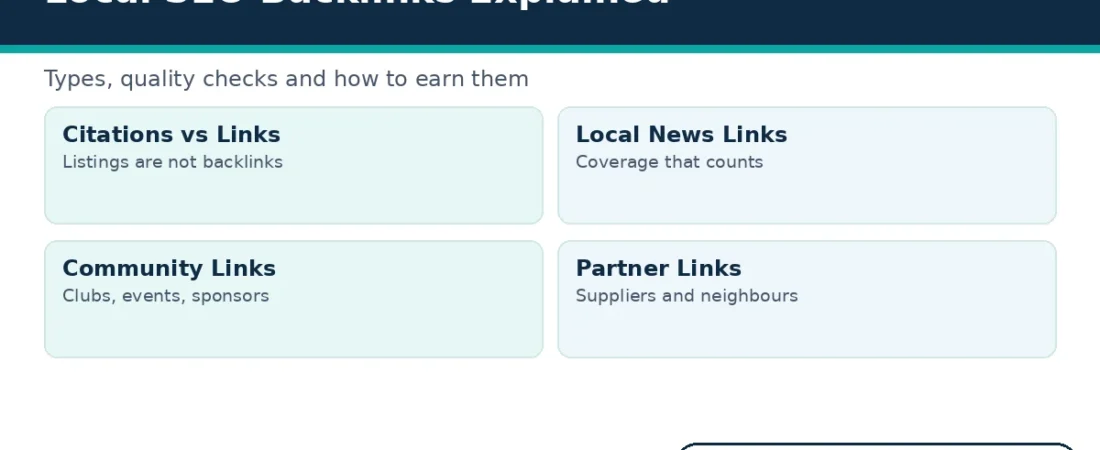
Local seo backlinks are links from websites in your own town, city or region that point to your pages. A link from the local newspaper, the chamber of commerce or a nearby supplier all count as local. Their value comes from shared geography and shared community, not from the size of the linking site alone.
However, many owners confuse these links with citations, and the confusion wastes budget. This guide separates the two ideas clearly. It covers the main types worth earning, five quality checks, and one worked example you can follow.
First, one point of scope. This article explains the types of local links and how to judge their quality. Our local link building guide covers the earning tactics step by step, so the two guides work as a pair.
What Local SEO Backlinks Are
A local backlink is any link to your site from a source with a genuine tie to your area. The source might serve your city, your county or your neighbourhood. Above all, a real person in your area should recognise the source as part of local life.
Search engines follow links to discover pages and to judge trust. Google explains this crawling and indexing role in its SEO Starter Guide. A link from a trusted local source therefore tells Google two things at once. Your business exists, and your community vouches for it.
Strong local seo backlinks share three traits. First, the linking site serves your area or your trade. Next, the link sits inside real content, not a footer or a link list. Finally, the source has real local readers who trust it.
Local links also punch above their weight. A national site may look stronger on paper, yet it says nothing about your place in one town. In contrast, a modest chamber page ties your business to a real community. Therefore, search engines and customers both read local links as proof that you belong in local results.
Local SEO Backlinks vs Citations: The Distinction That Matters
Many owners treat citations and local seo backlinks as one thing. They are not, and the difference decides where your money should go. A citation is a mention of your business name, address and phone number on another site. A backlink is an actual clickable link to your pages.
Citations support consistency. They help search engines confirm that your business details are correct across the web. Most directory citations carry a nofollow link or no link at all, so they pass little ranking signal. Their job is verification, not endorsement.
Citations live in predictable places. Directories, listing platforms and data aggregators carry most of them. Each one repeats your name, address and phone number. However, one wrong digit or one old address can split that picture. Therefore, fix your citations first, and keep every listing identical.
Backlinks work differently. An editorial link inside a news story or a partner page acts as a vote for your content. Therefore, citations keep your details straight, while backlinks build your authority. A healthy local profile needs both, in the right order.
The Main Types of Local SEO Backlinks
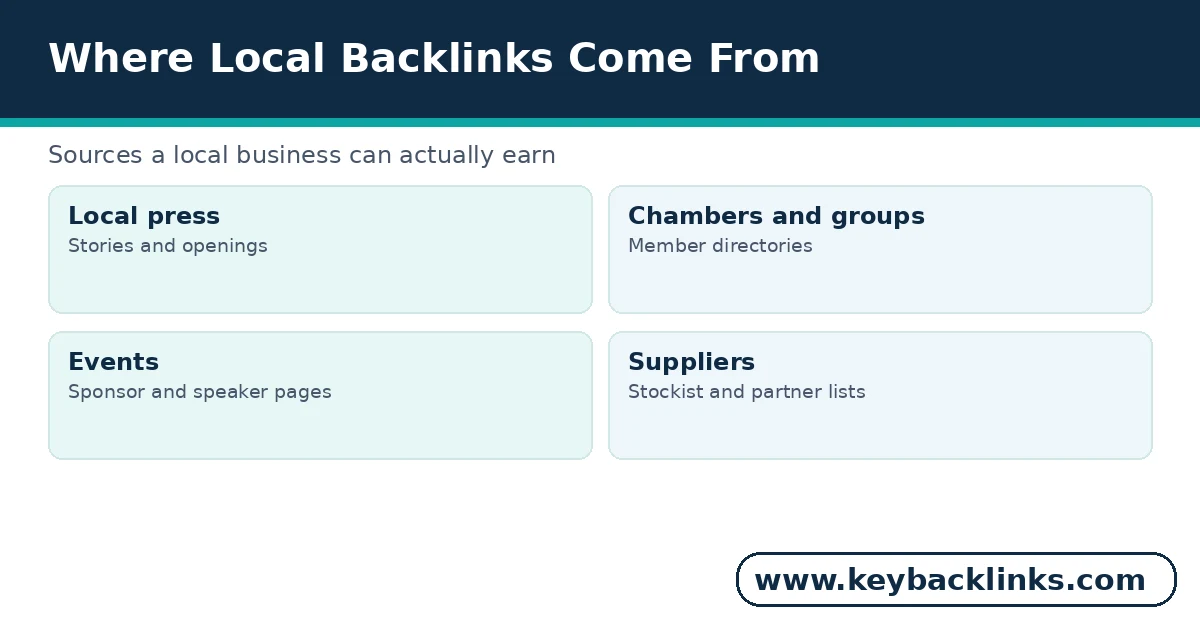
Six sources produce most genuine local links. Each one grows from a real relationship or a real story. Therefore, the work feels more like community involvement than marketing.
Local News and Community Media
Local newspapers and community sites need stories every week. A new service, a charity effort or an unusual job can all earn coverage. The resulting link usually sits inside the story text, which makes it both editorial and local.
Chambers and Business Groups
Chambers of commerce and trade groups list their members online. A member profile often links to your website. These links rarely stand alone, but they confirm your place in the local business community.
Events and Sponsorships
Sponsoring a fun run, a school fair or a youth team puts your name in front of neighbours. Event pages and sponsor lists often link back to supporters. Choose events your customers actually attend, not events chosen only for a link.
Suppliers and Business Partners
Your suppliers, distributors and partner firms already know your work. A partner page, a case note or a shared offer can carry a natural link. Ask only where the relationship is real and visible to customers.
Charities and Community Pages
Local charities and clubs publish supporter and thank you pages. Genuine help, such as donated services or prizes, can earn a mention and a link. The help must come first, or the link looks bought.
Local Resource Pages
Libraries, councils and community blogs keep lists of helpful local resources. If your guide or service genuinely helps residents, suggest it politely. Editors add resources that serve readers, not resources that merely ask.
No single type carries a local profile alone. Instead, mix two or three sources that fit your real relationships. For example, a trades firm might combine a chamber profile, a supplier page and one news story. That mix looks natural, because it mirrors how the business actually operates locally.
Five Quality Checks for Local SEO Backlinks
Not every local link deserves a place in your profile. Run each prospect through five checks before you count it as a win. Our backlink quality metrics guide covers the deeper measures, but these five checks catch most problems early.
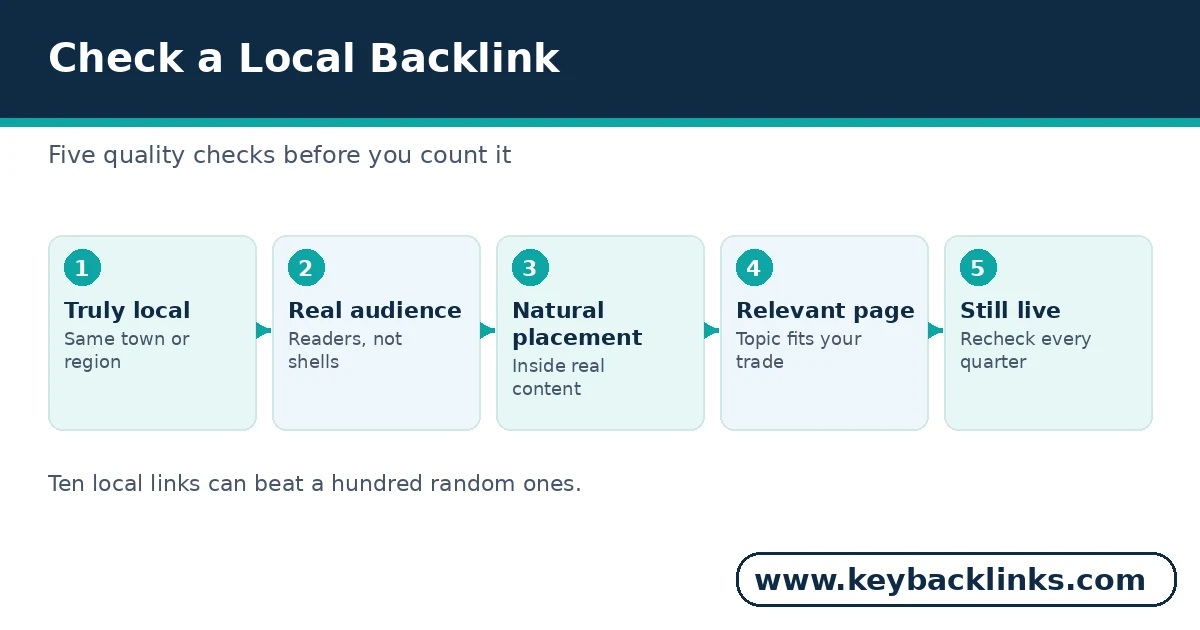
First, check local relevance: the source should serve your area or your customers. Next, check the audience: real local readers matter more than any authority score. Then check placement: the link should sit inside useful content with a natural anchor. Also, check consistency: your business details on that page should match your listings exactly. Finally, check the pattern: one link from each of several local sources beats ten links from one directory.
Example: a directory page lists forty plumbers and shows your phone number with one digit wrong. That link fails the audience, placement and consistency checks at once. In contrast, one chamber profile with correct details passes all five checks easily.
The checks also protect your budget. They stop you paying premium prices for listings that add nothing new. Moreover, they give you a clear reason to decline a weak offer. A seller who cannot answer these five points rarely has a quality link to sell.
A Worked Example: Two Links Earned Step by Step
The following example is fictional. It uses a made up business, but every step follows the methods in this guide.
Maya runs a small bakery in a coastal town. Her site had citations on the main directories, but no editorial links at all. She started with relationships she already had, instead of cold outreach.
First, she joined the town chamber of commerce and completed her member profile carefully. The profile linked to her website and used the same name, address and phone details as her listings. That link confirmed her place in the local business community.
Next, she offered free pastries to the finish line team at a charity fun run. The local news site covered the event and named her bakery in the story. The story linked to her site from the sentence about the sponsors. By the end of the month, she held two genuine local seo backlinks. One was the chamber profile, and the other was the editorial news link.
Finally, she repeated the pattern slowly. She suggested her wedding cake guide to a community events page, which added it the next month. Each link came from a real local relationship, so the profile stayed clean.
She also kept a simple record of the work. A short list noted each source, its live URL and the date it appeared. Therefore, she could see her local profile growing source by source. That habit takes minutes, yet it stops duplicate outreach and wasted effort later.
How Many Do You Need?
There is no fixed number, and anyone who quotes one is guessing. Instead, compare your profile with the local rivals who outrank you. Count their local referring sources, not their total link counts.
Then close the gap gradually, source by source. A handful of relevant local links often outweighs a large bundle of generic ones. Above all, stop when each new link still adds a new, relevant local source.
Pace matters as much as the total. For a small business, one or two genuine local links in a month is healthy, steady progress. Overall, that pace matches real community involvement, because events, stories and partnerships take time to arrange. A sudden burst of fifty local links, however, matches a purchase, not a community.
What to Avoid
Some offers sound local but are not. Sellers often repackage bulk directory submissions as local seo backlinks, then submit your details to hundreds of thin sites. These blasts add risk, and they can leave your business details scattered in versions you never approved.
Also avoid national links sold as local ones. A link from an unrelated site adds no local signal, whatever the sales page claims. Fake partnerships belong on the same list, because invented relationships collapse under one phone call.
Reciprocal deals with distant businesses deserve the same caution. A link swap with a firm in another region, arranged only for links, fools nobody local. Search engines can also discount such patterns once they repeat. Genuine partnerships, in contrast, survive because customers can see them working.
Local Links, Built Carefully at KeyBacklinks
At KeyBacklinks, local link work starts with your citations and your current profile. Then we target the sources in this guide, from chambers to community media. Our local SEO services guide explains how links fit the wider local plan.
Each placement is checked against the five quality checks above before it counts. Reporting lists the live URL, the anchor and the target page for every link. If you want local seo backlinks built this way, request a free quote. Tell us about your business and your town, and we will map your first targets.
Frequently Asked Questions
Do citations count as local seo backlinks?
No. In fact, a citation is only a mention of your business details, while a backlink is a clickable link to your pages. Citations confirm your details, and backlinks build authority. You need both, but you should never pay backlink prices for plain citations.
How long do local backlinks take to earn?
Most come from relationships, so they arrive in weeks rather than days. A chamber profile can go live quickly, while a news link waits for the right story. Steady work over a few months builds a profile that lasts.
Are directory links worth anything now?
A few accurate listings on respected local directories still help customers find you. Their value sits in consistency and discovery, not in ranking power. However, mass directory submissions and paid blasts add risk instead of value.
Can one strong local link beat many weak ones?
Yes. One editorial link from a trusted local news site can outweigh dozens of thin directory links. Search engines weigh relevance and trust, not raw counts. Therefore, chase sources your customers respect.
Conclusion
Local seo backlinks come from real ties to your town: newsrooms, chambers, partners and community pages. Citations keep your details consistent, while editorial links build the authority that citations cannot. Keep the two jobs separate, and judge every link with the five checks.
Start with the relationships you already hold. Earn one genuine local link, then another, and let the profile grow at a natural pace. In short, that steady pattern is what search engines trust, and local rivals cannot copy it quickly.