
Local SEO services help a business become easier to find when nearby customers search for what it offers. They improve the information, pages, reviews, and links that shape local visibility. As a result, buyers can understand the business faster and choose it with more confidence.
However, the label alone tells you very little. One provider may manage your profile and reviews each month. Another may send a brief report and do little else. Therefore, you need to compare the actual work, not the sales language.
This guide opens up local seo services in plain terms. It explains all seven core components, the monthly deliverables behind them, and five checks for choosing a provider. It also separates honest reporting from promises no provider can control.
What Local SEO Services Are
Local seo services support searches with a place based intent. A customer may search for a service, add a city, or use a phrase such as near me. Google can then show a map result, business profiles, and regular web pages.
Good work joins those surfaces together. Your profile must describe the business clearly. Your website must support the same services and service areas. Also, reviews, citations, and local links must reinforce the same trustworthy picture.
Local work is ongoing because business details change. Staff add services, hours shift, customers leave reviews, and competitors update their pages. A monthly service should maintain the full system rather than complete one checklist and disappear.
The Seven Components Behind the Label
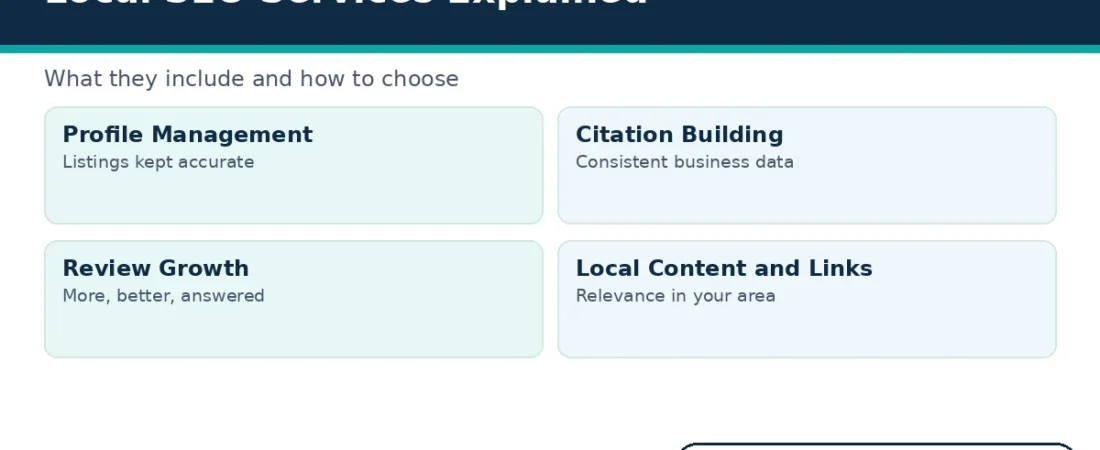
Most complete local seo services combine seven kinds of work. Each component has a distinct job. Together, they help customers find accurate information and help search engines understand where the business belongs.
1. Google Business Profile Management
First, the provider should claim, verify, and maintain your Google Business Profile. Monthly work can include categories, services, hours, attributes, photos, products, and service areas. The provider should also remove duplicates and correct misleading details quickly.
Our companion guide explains Google Business Profile optimization for AI local search in more detail. It shows how clear profile data supports both map results and newer answer formats.
2. Citation Building and Cleanup
Next, citations list your business name, address, and phone number across directories and data sources. A provider should build relevant listings, fill missing fields, and fix conflicting records. Consistency matters because customers and search systems both rely on those details.
Google explains profile and listing controls through Google Business Help. Still, your provider should maintain a citation log. That log should name each site, show the live listing, and record every correction.
3. Review Management
Reviews give buyers social proof and give the business direct feedback. A provider can set up a simple request process, monitor new reviews, and draft professional responses. The business should still approve sensitive replies and solve real service problems itself.
Never accept fake reviews, paid praise, or review gating. Those tactics mislead customers and can damage trust. Instead, ask satisfied customers honestly, respond with care, and use recurring complaints to improve the service.
4. Local Content and Location Pages
Local content explains what you do, where you work, and why nearby customers should care. Useful pages may cover one service, one neighborhood, or one service area. Each page needs original details, clear calls to action, and helpful internal links.
Thin city pages do not meet that standard. For example, our Florida local SEO guide treats seasons, service areas, and local intent as real planning inputs. Strong local content follows the same principle in any market.
5. Local Link Building
Local links connect your business to its community and industry. Relevant sources can include local publishers, chambers, event pages, suppliers, charities, and partner businesses. The link should arise from a real relationship, useful content, or genuine participation.
Our local link building guide explains the tactics in depth. In short, relevance and trust matter more than raw link counts. A provider should report each live URL and explain why the source fits.
6. Local Tracking and Maintenance
Tracking shows how visibility changes across places and search terms. A provider may monitor profile views, map visibility, calls, direction requests, and priority keywords. It should also watch for wrong hours, duplicate profiles, broken links, and sudden review issues.
Tracking is not the work itself. It tells the team where to act next. For example, weak visibility in one service area may point to thin content, poor citations, or too few relevant local links.
7. Clear Monthly Reporting
Finally, reporting should connect actions to outcomes. It should list completed work, live URLs, profile changes, review activity, and the next planned tasks. It should also explain visibility and customer action trends without hiding weak results.
A useful report helps you make decisions. You should know what changed, why it changed, and what the provider will do next. A single ranking chart cannot answer those questions.
Monthly Deliverables at a Glance
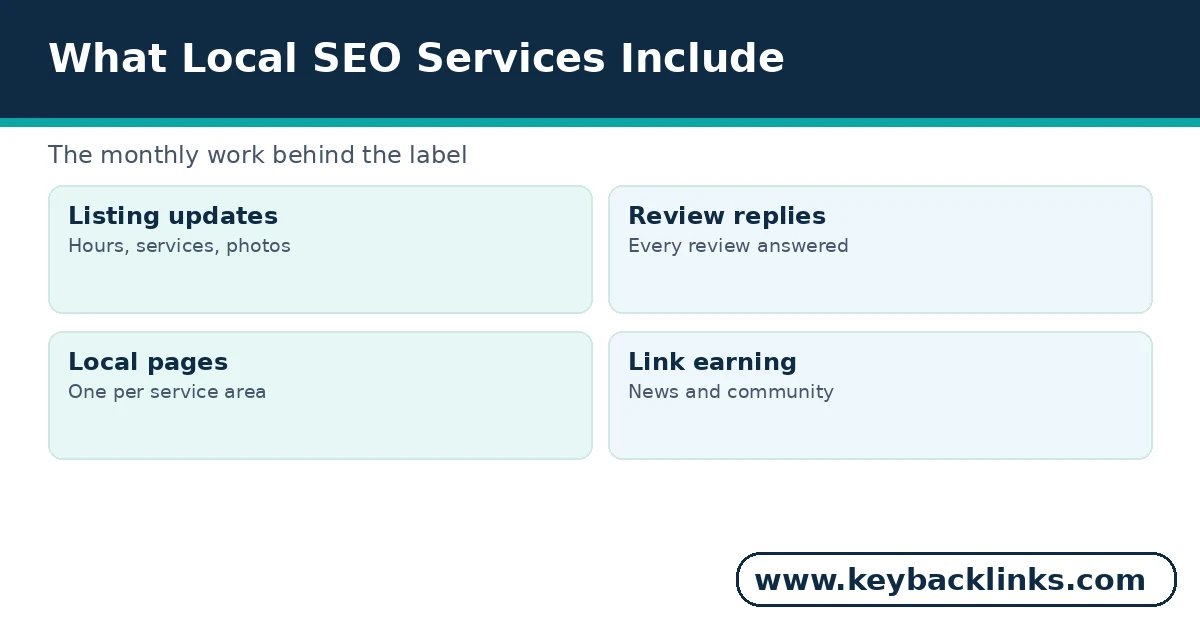
Use this table to compare local seo services on work you can inspect. Exact tasks vary by business, but every promised item should have an owner, a record, and a visible output.
How Local SEO Differs From National SEO
National SEO usually targets customers across a country or a broad online market. Local seo services focus on a physical location, a service area, or several nearby markets. That narrower audience changes the evidence, pages, and measures of progress.
For example, a national campaign may prioritize broad guides and digital PR. A local campaign also needs accurate profiles, citations, reviews, and community links. Its content must name real services and places without turning every page into a copied city template.
Competition also stays closer to home. You may compete with a small group of nearby firms rather than national brands. Therefore, clear details, strong reviews, and trusted local relationships can matter as much as general website authority.
Five Checks Before Hiring Local SEO Services
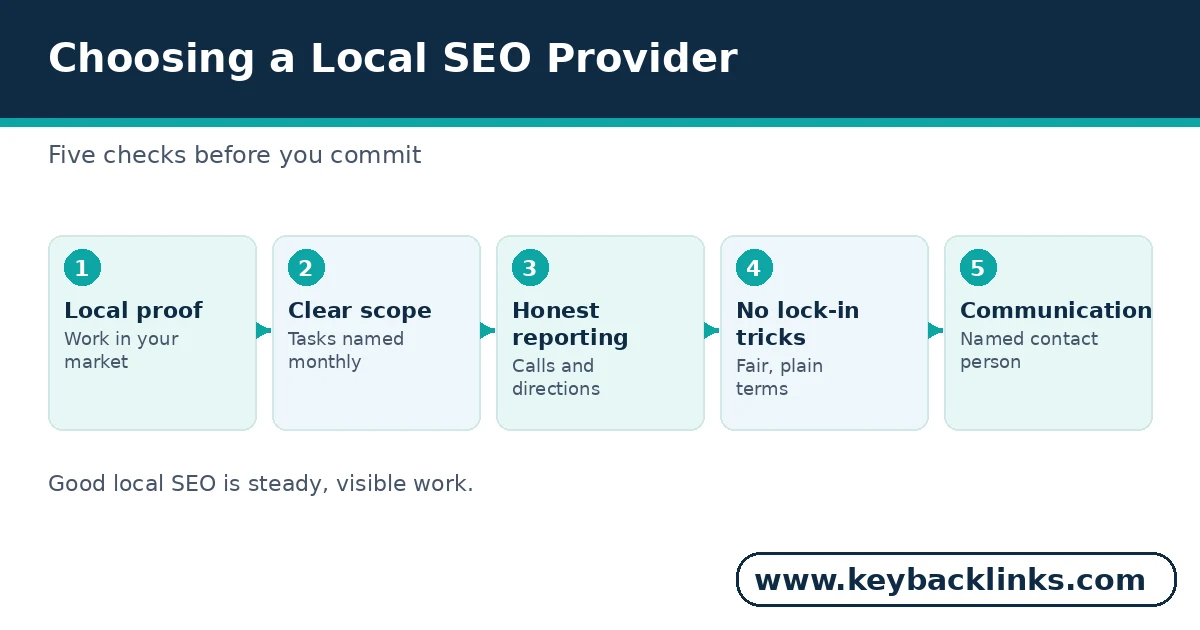
Before you hire local seo services, test the provider against five practical checks. Ask for examples of records and reports, not broad claims. A careful provider should welcome the questions and answer each one directly.
Check One: Named Monthly Work
Ask what the team will complete in the first three months. The answer should name profile tasks, content work, citation actions, and link activity. Vague promises about visibility do not give you anything to manage.
Check Two: Transparent Methods
Ask how the provider earns reviews and links. Safe answers describe real customers, relevant partners, and editorial standards. Walk away from fake reviews, hidden networks, bulk directory blasts, and guaranteed map positions.
Check Three: Access and Ownership
Confirm who owns the profile, listings, content, and reports. Your business should keep administrative access and receive the underlying records. A provider should never hold your profile hostage when a contract ends.
Check Four: Local Fit
Ask how the plan changes for your market, service area, and business model. A single location, a home service firm, and a multi location brand need different priorities. The provider should explain those differences clearly.
Check Five: Useful Reporting
Request a sample report before you sign. It should show work completed, customer actions, visibility trends, problems, and next steps. It should also separate activity from outcomes, so you can judge both fairly.
What Reporting Should Show
A monthly report should start with the work log. It should name profile edits, citation fixes, published pages, review actions, and live links. Then it should show the customer side of the profile, including calls, direction requests, and search views.
Those fields describe what customers did during the period. They do not prove that one task caused every change. Seasonality, reviews, competitors, and Google updates can also move the numbers. Honest reporting explains that context instead of claiming total control.
Next, the report should cover visibility for priority services and areas. It should flag pages that lost ground, profiles with wrong data, and terms that need better content. Above all, it should end with dated actions and a named owner for each action.
A Practical Monthly Rhythm
A steady rhythm prevents local work from becoming random. First, the provider checks the facts. Next, the team improves the pages. Then, it builds local trust. Finally, it reviews the evidence and chooses the next actions.
Week One: Check and Correct
First, review the profile for wrong hours, missing services, and duplicate listings. Next, compare key citations with the correct business details. Then, record every fix in the work log. As a result, customers see one consistent version of the business.
Week Two: Publish and Improve
First, choose one service or service area that needs stronger content. Next, add original details, useful questions, photos, and internal links. Then, check the page on mobile and confirm the call to action works. Therefore, the improvement stays practical and easy to measure.
Week Three: Build Relationships
First, list local partners, events, publishers, and community groups that fit the business. Next, offer something useful, such as expert help, sponsorship support, or a helpful resource. Then, record replies and agreed placements. In short, real relationships create stronger local relevance than bulk submissions.
Week Four: Review and Decide
First, compare calls, direction requests, search views, reviews, and priority visibility with the prior period. Next, identify the pages and areas that moved. Then, name the likely reasons without overstating cause. Finally, assign the next month’s tasks and give each task an owner.
DIY or Done for You?
You can handle basic local seo services yourself if you have time and one location. Claim the profile, fix your details, publish useful service pages, and answer every review. Those tasks require consistency more than advanced technical skill.
However, the workload grows with locations, service areas, and competitors. Citation cleanup, content planning, outreach, and reporting can consume steady weekly hours. A provider may help when your team lacks time, process, or specialist support.
A hybrid model often works well. Your team can supply photos, service updates, and customer feedback. The provider can manage audits, content, citations, tracking, and links. That split keeps local knowledge inside the business and execution on a clear schedule.
Where Link Building Fits
Links do not replace accurate profiles or useful pages. They strengthen the wider system by showing that trusted local and industry sources connect with your business. Therefore, local seo services should treat link building as one component, not the whole strategy.
KeyBacklinks focuses on that link building side. We research relevant local and industry sources, check fit carefully, and report live placements clearly. We do not present link building as a complete local SEO service, because profile management, reviews, content, and citations need their own work.
If links are the missing piece in your local plan, request a local link building quote and tell us your market, services, and target pages. We can then judge fit honestly and explain the next step.
Frequently Asked Questions
What do local seo services include?
They usually include profile management, citations, reviews, local content, local links, tracking, and reporting. The exact mix depends on your locations, service areas, and current weaknesses. Ask the provider to name monthly deliverables before work begins.
How long does local SEO take?
Profile corrections and content fixes can land quickly. Visibility and customer actions usually need a longer trend because competitors, reviews, and search systems keep changing. Judge progress through monthly work records and several periods of data.
Can I buy local seo services for one location?
Yes. A single location still needs accurate data, useful service pages, reviews, citations, and relevant links. The scope may be smaller than a multi location plan. Still, the provider should define every task and report it clearly.
Do local links matter if I have good reviews?
Yes, because reviews and links answer different questions. Reviews show customer experience, while links show outside relevance and trust. A balanced local plan needs both, along with accurate profile data and helpful local content.
Conclusion
The best local seo services make their work easy to inspect. They maintain your profile, fix citations, support honest reviews, publish useful local content, earn relevant links, and report every action clearly.
Start by naming the gaps in your current local presence. Then choose a provider whose methods, ownership terms, and reporting pass the five checks. That approach turns a vague service label into a practical monthly plan.