

Anchor text analysis is a review of the clickable words in the links that point to your site. It shows what other pages say about your pages, and how those words fit each link topic. A clear review helps you spot patterns and avoid quick judgments based on one link alone.
Start with a simple question. Do the anchors describe the linked page in a natural way? If most anchors look like real descriptions, brand names, or plain web addresses, the profile often looks normal. If many anchors repeat the same sales phrase, look closer.
What Anchor Text Is
Anchor text is the visible, clickable text of a link. In "Read our backlink audit checklist," those three words are the anchor text. Search engines and readers use them as a clue about the linked page.
However, anchor text does not prove that a page is good or bad. It is one signal among many. Relevance, placement, and the quality of the source page also matter. Review anchors together with the link around them. A single odd anchor is rarely a problem.
Anchor Text Analysis: The Main Anchor Types
Most anchors fall into a small set of types. Learn them first, because the mix tells you more than any single anchor.
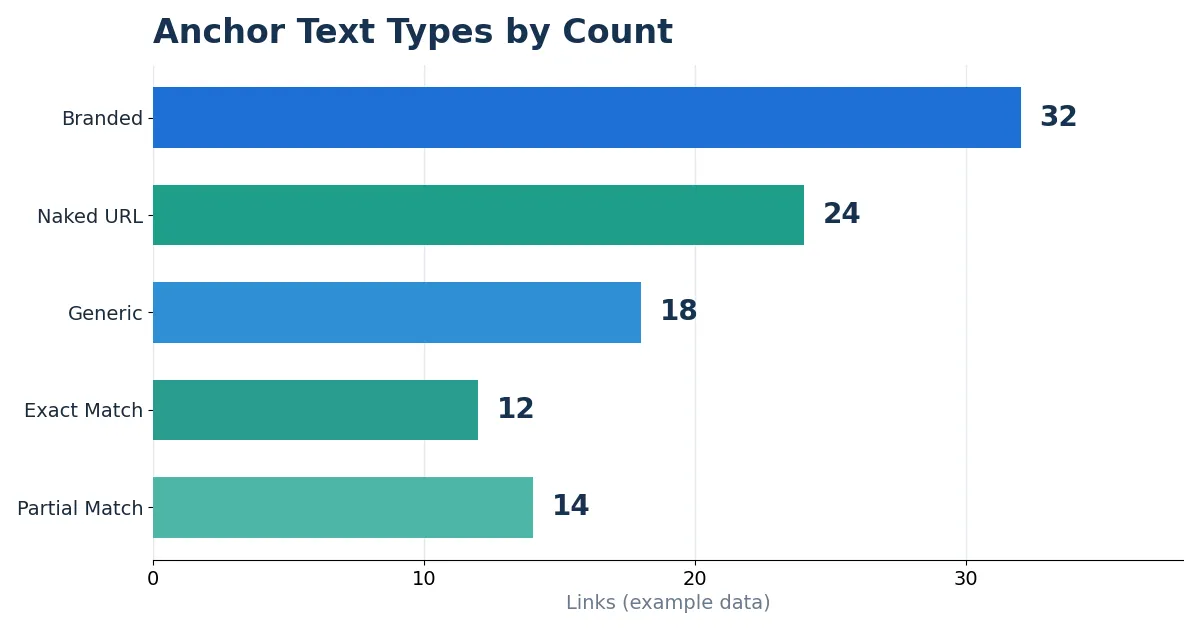
Example chart: anchor type counts from a small example review. The numbers are examples for illustration only, not results from a real site.
Count the types before you judge them. First, list the anchors you can see. Next, sort each one into a type. Then, look at the mix across the whole set. A mix with branded, naked URL, generic, and related anchors is common.
Example Results in Numbers
The table below shows example counts from a small review. These numbers are examples only, not results from a real site.
How to Run Anchor Text Analysis
Use a repeatable process. It keeps the review fair and makes the next review easy to compare.
Step 1: Build Your Anchor List
First, export the links that point to your site. Keep the source page URL, target URL, anchor text, and link type for each link. If a link has no anchor text, note that too.
Next, remove exact duplicates, then sort the list by target page.
Step 2: Group Anchors by Type and Target
Next, group the anchors by type and by target page. For each target page, ask three questions. What is the most common anchor type? Does the anchor describe the page? Does it match the page topic?
For example, a guide about monitoring links should attract anchors about monitoring and tracking. If it attracts anchors about a different product, check the source page.
Step 3: Check the Most Common Anchors
Then, look at the anchors that appear most often. Then, check where those anchors come from. Are they from many different sites, or from one site with many pages? Links from many sites carry more weight than links from one site.
Also, check the share of each top anchor. Do not use a fixed percentage rule. No public rule says a set share is safe or unsafe. If one phrase dominates, note it as a pattern to review.
Step 4: Review Anchors in Context
In addition, this step matters most. Open the source page for the anchors that concern you. Read the sentence around the link, and check the paragraph, the heading, and the topic of the page. A good anchor fits the sentence. A forced anchor stands out.
Also, check where the link sits on the page. A link in the main content often has more context than a link in a footer or a sidebar.
For a full review of the links around the anchors, use the backlink audit checklist. For ongoing checks, use the how to monitor backlinks guide.
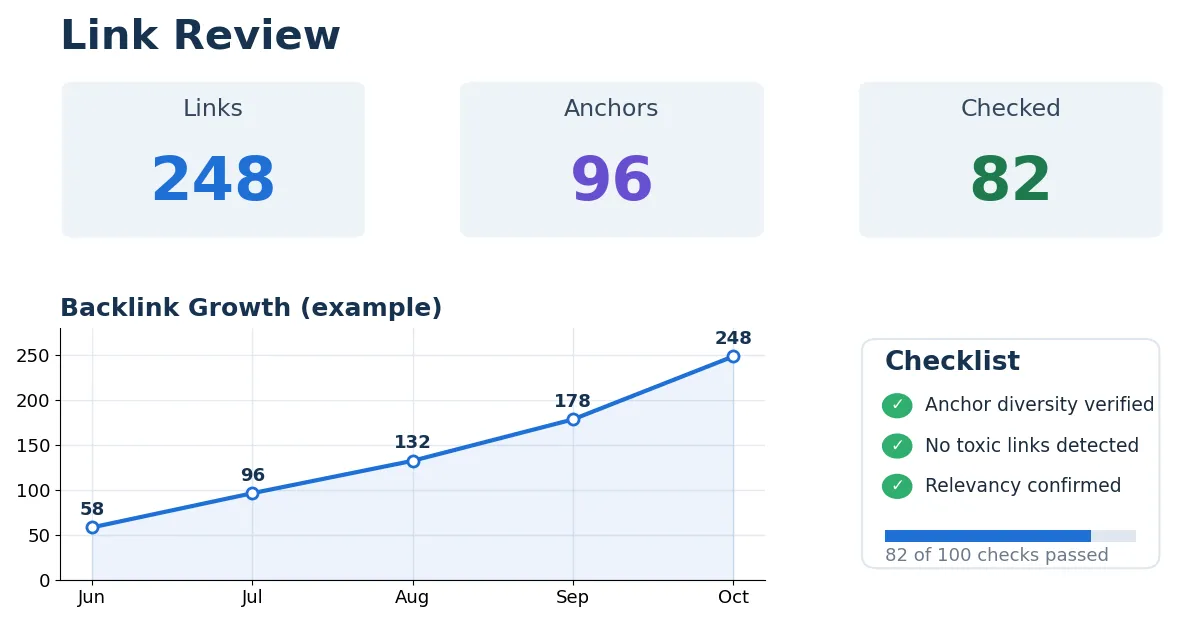
Example dashboard: link review results from a small example review. The numbers are examples for illustration only, not results from a real site.
Over-Optimisation Signals to Watch
Over-optimisation is not one anchor. Instead, it is a pattern. Watch for these signals, and treat each one as a reason to look closer, not as proof of a problem.
First, watch for the same exact-match phrase on many links from different sites. Natural links vary, using brand names, plain addresses, and related phrases. When the same sales phrase repeats, the pattern looks forced.
Second, watch for anchors that do not match the linked page. For example, if the anchor promises one topic and the page covers another, check the source page before you act.
Third, watch for a sudden change. Note the date and source sites when a new set of links appears with the same anchor in a short time. Then, check whether the links are still live.
Finally, watch for anchors that repeat a commercial phrase with a location or a price. A real review may use such a phrase once. The same phrase on many sites is a stronger signal.
Do not act on a single signal. Combine the anchor pattern with the source quality, the placement, and the target page. For more on what makes a link strong, read the Ahrefs guide on what makes a high-quality backlink. Google also explains link spam in its spam policies.
Anchor Text Analysis Worksheet
Use this worksheet to record what you find.
Work through one target page at a time, starting with the pages with the most links.
Common Mistakes in Anchor Text Analysis
First, do not judge a profile by one anchor. For example, a single exact-match link is normal. A pattern across many links is what matters.
Second, do not use a fixed percentage formula. No public formula proves that a set share of exact-match anchors is safe. Shares vary by niche, by brand, and by site age.
Third, do not ignore image links. An image link can carry alt text, and that alt text acts as the anchor. Check it the same way you check visible text.
Fourth, do not skip the source page. An anchor that looks odd in a spreadsheet can look normal in context. Open the page.
Fifth, do not act on a score alone. A tool score does not prove that a link is bad. Check the source, the placement, and the context. For a wider view, see the backlink quality metrics guide and the competitor backlink analysis guide.
Frequently Asked Questions
What is anchor text analysis?
Anchor text analysis is a review of the clickable words in the links that point to your site. It groups anchors by type, checks the most common phrases, and reviews each anchor in context.
How often should I run anchor text analysis?
Run it when you audit your links, after a large change in your link profile, or when a new set of links appears. For most sites, a review every few months is enough.
Does anchor text analysis help with link reclamation?
Yes. When you review anchors, you may find links that point to the wrong page or use an outdated brand name. The link reclamation guide explains how to fix those cases.
Conclusion
Anchor text analysis works best as a review, not as a hunt for one bad phrase. Start with the anchor types. Then, group anchors by target page. Next, check the most common phrases. Finally, read each anchor in context before you decide.
In contrast, a natural profile has variety: brand names, plain addresses, generic words, and related phrases. A forced profile repeats one phrase too often. When you see a pattern, record it, check the source, and decide whether to keep, monitor, or investigate further.