
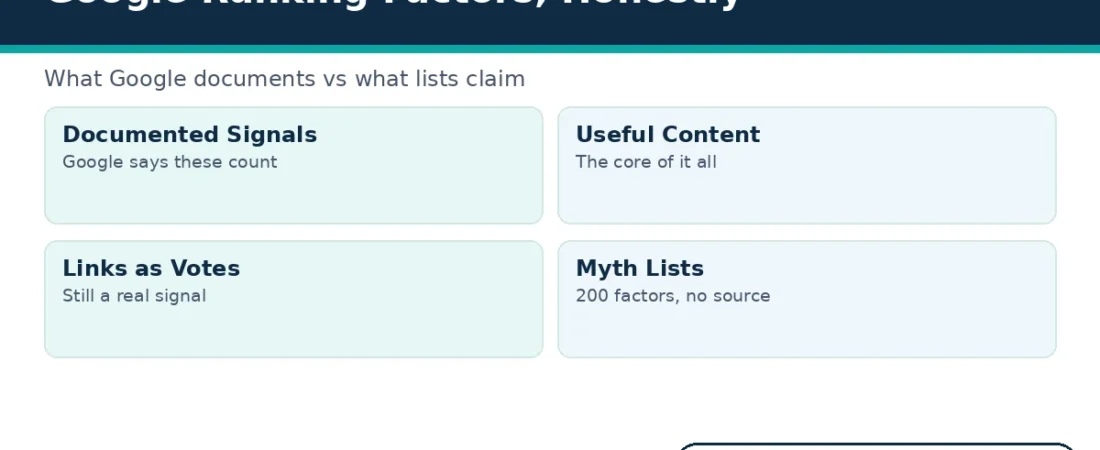
Search for google ranking factors and you will meet very confident lists. Some name ten factors, while others claim two hundred or more. Almost none of them come from Google itself.
Here is the honest starting point. Google has never published a complete list of google ranking factors. It has also never shared weights for the signals it does use.
The famous two hundred factors figure traces back to a claim from around 2009. Bloggers and tool companies have repeated it ever since. Treat every such list as a third-party summary, not as a Google document.
This guide takes a stricter approach. First, it covers only the signals Google documents in its own guidance. Next, it separates those signals from popular claims with no proof. Finally, it ends with five priorities you can act on today.
What Google Has Never Published
Google describes its ranking systems in broad terms only. Its public pages explain that automated systems consider many signals when they sort results. However, Google never lists those signals in one ranked table. It also never assigns them public weights or scores.
So nobody outside Google can hand you the full recipe. Anyone who sells you an exact list is repackaging guesswork. Some guesses are sensible, but sensible guesses are still guesses.
That is why lists of google ranking factors disagree so wildly. One blog promotes a signal that another blog dismisses completely. Without a published source, neither side can settle the argument.
The gap matters for your budget too. Money spent chasing a rumoured factor is money not spent on documented work. Therefore, start from what Google confirms, and treat the rest as background noise.
The systems also change constantly. Google announces core updates and spam updates on its Search Status Dashboard. Each update adjusts how the existing signals work together. None of these announcements publishes a factor list either. So even a perfect snapshot of today’s systems would age quickly.
Google Ranking Factors Google Actually Documents
Every item in this section traces back to Google’s own documentation. Google collects many of these basics in its SEO Starter Guide. The google ranking factors below come only from pages Google itself publishes.
Helpful, People-First Content
Google’s helpful content guidance asks one simple question. Would a real person find this page useful and satisfying? Google says its systems aim to reward content made for people. Content made mainly to manipulate rankings sits on the wrong side of that guidance.
So write from real experience where you can. Answer the actual question behind the search. Then cut anything that exists only to fill space.
Relevance and Search Intent
Relevance is the match between a page and a search. Google studies the words on your page and how they relate to the query. It also weighs the searcher’s location, language and device.
Intent sits underneath relevance. A searcher who wants a price needs a different page from one who wants a tutorial. When your page matches the job behind the search, it fits the results set. Our keyword optimization guide shows how to map one intent to one page.
Links From Other Websites
Links remain a documented part of how Google judges pages. Google explains that links help its systems discover new pages across the web. Its own materials also describe links as one signal among many.
That does not make every link equal. A link from a relevant, trusted page carries more meaning than a link from a random directory. Our guide on how to check backlinks shows how to inspect the links you already have.
Page Experience and Core Web Vitals
Google documents page experience as part of its ranking systems. Core Web Vitals measure loading speed, responsiveness and visual stability. Google presents them as one part of a broader page experience picture.
So strong scores alone will not rescue weak content. However, a slow or unstable page can hold back otherwise good work. Treat these measures as hygiene, not as a ranking trick.
Crawlability and Indexability
None of the other signals matter if Google cannot reach your page. Google must crawl a page and add it to its index before the page can rank. Blocked resources, server errors and stray noindex tags break that chain.
Technical work protects this foundation. Our technical SEO services companion explains what a proper technical review covers.
Structured Data, Framed Honestly
Structured data helps Google understand what your content means. It can also make a page eligible for rich results, such as review stars or event details. Eligibility is the honest word here. Google does not present structured data as a general ranking boost.
So add structured data only where it describes your page accurately. Never mark up content that visitors cannot see on the page.
Topical Depth and Clear Structure
Google’s guidance encourages organised sites with descriptive addresses and grouped topics. A clear structure helps Google find every page on your site. It also helps Google understand how your pages relate to each other.
Depth works the same way. A page that answers the follow-up questions earns its place better than a thin page does. However, depth means useful coverage, not extra paragraphs of filler.
Mobile-First Indexing and HTTPS
Google now indexes the mobile version of most sites first. Its documentation calls this mobile-first indexing. So the content on your mobile pages is the content Google mainly judges. Content hidden or missing on mobile can therefore cost you visibility.
Security has a documented place as well. Google announced HTTPS as a ranking signal back in 2014. It describes the effect as small compared with content quality. Still, a secure connection is now the baseline expectation for any serious site.
Freshness Where the Query Deserves It
Some searches clearly need recent information. News topics, product releases and prices all change quickly. Google’s guidance acknowledges that its systems favour fresher content for such searches. For evergreen topics, however, an older page can hold its place for years.
So update pages when the facts genuinely change. Also, refresh examples and screenshots when they fall behind. Never fake freshness by changing a date without improving the page.
E-E-A-T Is a Rater Lens, Not a Factor
E-E-A-T stands for experience, expertise, authoritativeness and trust. Google uses these ideas in its search quality rater guidelines. Human raters score sample results against those guidelines. Google then uses their feedback to test and improve its systems.
Here is the distinction that matters. E-E-A-T is not a direct ranking factor with a score you can raise. No E-E-A-T dial sits inside the ranking systems. Still, the qualities raters look for overlap with what Google tries to reward. So build real experience into your pages, and credit your authors honestly.
Taken together, the documented signals share one theme. Google keeps pointing site owners back to the searcher. Helpful content, honest links and a healthy site serve real visitors first. The ranking benefit then follows from that service. Whenever advice conflicts with the searcher’s interest, the documented side is the safer bet.
Claimed Google Ranking Factors to Treat Carefully
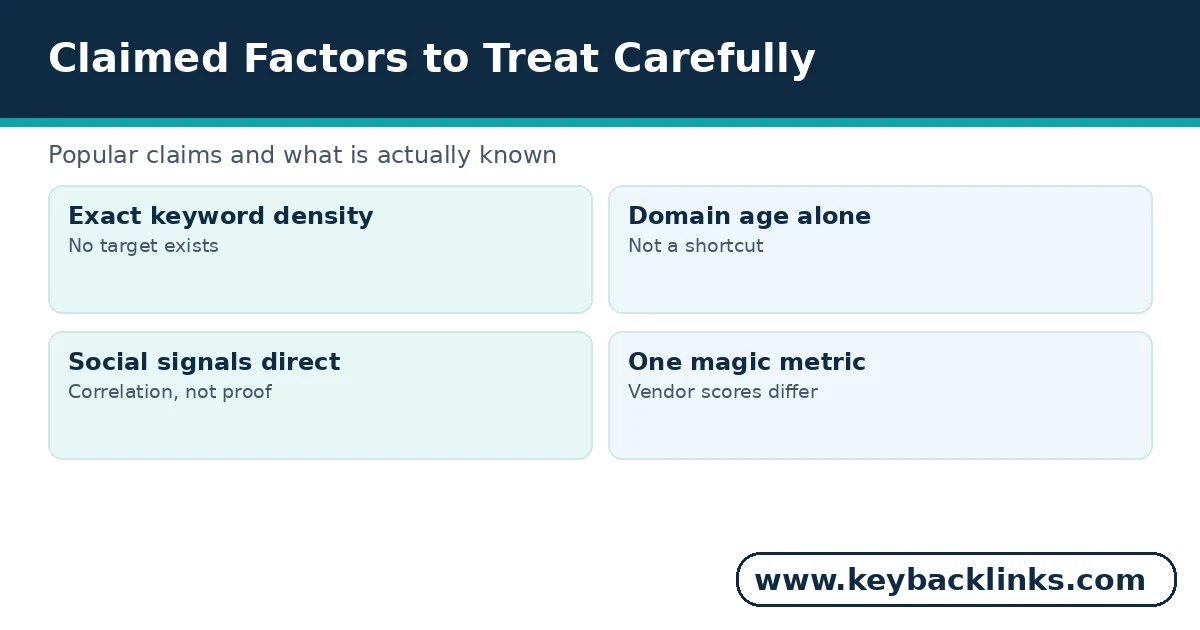
The claims below appear in factor lists everywhere. None of them arrives with confirmation from Google. Some contain a grain of truth, which is exactly why they spread so well.
Exact Keyword Density
Writers still ask for the perfect keyword density percentage. No such target exists in Google’s documentation. Google advises natural writing that serves the reader first. A page stuffed to hit a number usually reads badly and helps nobody.
Domain Age on Its Own
A new site can feel locked out by older rivals. However, domain age alone does not explain that gap. Older sites usually hold more content, more links and more history with users. Google has pushed back on age as a standalone factor. So a new site competes by building those real assets, not by waiting.
Direct Social Signals
Posts about google ranking factors often list social shares as a factor. The evidence behind that claim comes from correlation studies. Pages that rank well also tend to get shared, so the two patterns move together. Google has never confirmed social signals as a direct ranking input. Shares can still earn attention and links, and those indirect effects do help.
Single Vendor Metrics
SEO tools sell scores such as Domain Rating and Domain Authority. These scores belong to the tool companies, not to Google. Each company builds its score from its own crawl and its own formula. So two tools can grade the same site very differently.
Use such scores for rough comparisons inside one tool only. Never treat them as google ranking factors in their own right.
These claims persist for a simple reason. A precise number feels more useful than an honest principle. Sellers of courses and tools therefore prefer exact lists and thresholds. The claims also flatter hard work already done, such as collecting shares. However, feeling useful and being documented are very different things.
Five Priorities Worth Your Time
So where should a busy site owner start? Start with the google ranking factors that Google actually documents. The five priorities below follow that evidence, in order.
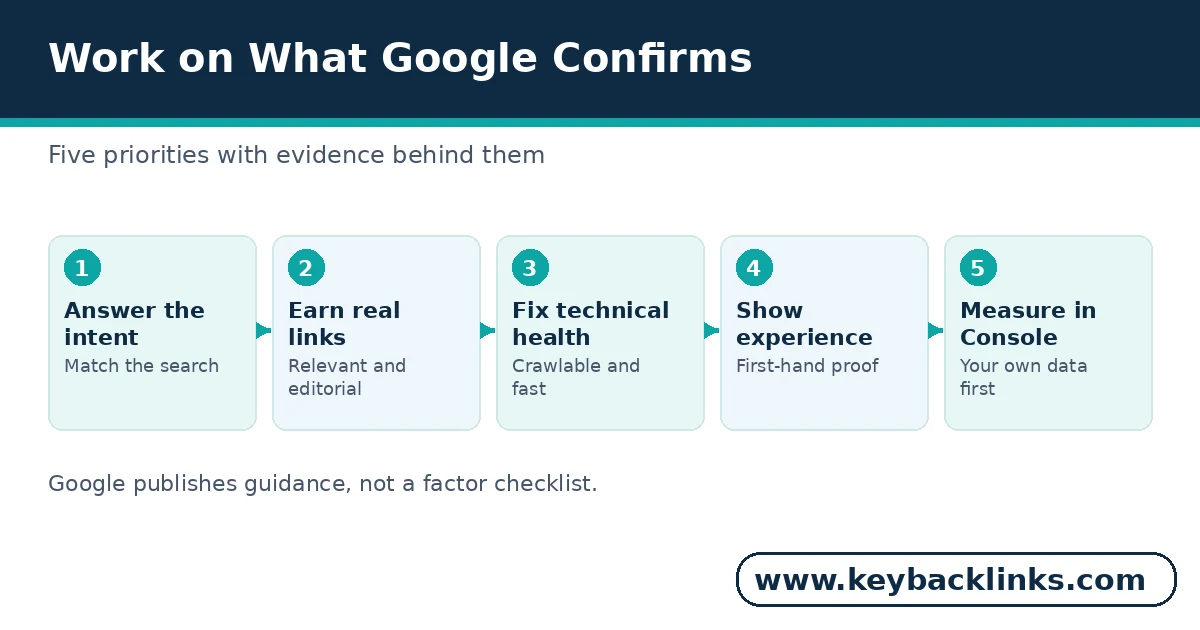
1. Answer the intent. Match each page to one clear search job, and satisfy that job fully.
2. Earn real links. Win links from relevant sites by publishing content worth citing.
3. Fix technical health. Keep every important page crawlable, indexable and fast enough for visitors.
4. Show experience. Publish first-hand knowledge, and credit the people behind each page.
5. Measure in Search Console. Judge every change with your own data before you trust outside claims.
This order is deliberate. Content and relevance come first because they define what you deserve to rank for. Technical health and links then decide how far that content can travel.
Popular Claims Checked Against the Guidance
Use the table below whenever a list of google ranking factors sounds too exact. It places each popular claim beside what Google actually documents.
Notice the pattern across the table. Every weak claim sounds precise, while Google’s real guidance sounds general. That happens because ranking systems combine many signals differently for every search.
How to Judge Any Factor Claim You Meet
Factor claims arrive through blogs, videos, courses and sales calls. New google ranking factors seem to appear every month. A few simple checks separate evidence from noise.
First, ask for the Google source. A genuine claim should point to a Google document, not to another blog post. Next, check the date, because guidance changes and old quotes linger for years. Then separate studies from statements, because a correlation study shows a pattern, not an instruction.
Watch out for two common disguises as well. Patent filings describe systems Google might build one day, not systems running today. Similarly, a ranking study shows what top pages share, not what Google rewards. Both sources can spark ideas, but neither one counts as confirmation.
Finally, test claims against your own data. Search Console shows your real pages, queries and positions. If a claimed factor mattered most, your own results would usually show it.
When the picture stays unclear, get the documented basics checked first. Our website SEO audit reviews crawlability, indexation and content signals before anything speculative.
Frequently Asked Questions
Does Google publish a list of google ranking factors?
No. Google has never released a complete list or any set of weights. It documents principles and individual systems instead.
What is the single most important ranking factor?
Google gives no single answer to that question. Its guidance returns to relevance and helpfulness for the searcher. The signal that matters most changes with each query and each competing page. Anyone who names one factor with a percentage is guessing, however confident they sound.
Is E-E-A-T a ranking factor?
Not directly. Raters use E-E-A-T ideas to judge the quality of sample results. Google then uses those judgements to improve its systems. Building real expertise still helps your pages, but no score exists to chase.
Do social media posts directly improve rankings?
Google has not confirmed that they do. Shares can put your content in front of people who later link to it. That indirect path is real, even though the direct claim stays unproven.
Conclusion
Google ranking factors are not a secret recipe waiting to leak one day. Google documents the principles clearly, and it keeps the exact recipe private. Work on helpful content, real relevance, honest links and a healthy, secure site. Then judge every new claim with one simple test: show me where Google says that.