
Technical seo services fix the machine room of a website. They cover how search engines crawl, render and index your pages. Content and links sit on top of this base. When the base breaks, even strong pages struggle to rank.
However, the problems are often invisible from the front end. A page can look perfect to visitors and still block Googlebot. Redirect chains, blocked files and duplicate versions hide in the code. Therefore, technical work always starts with evidence, not opinions.
This guide explains what the services cover and what you receive. It also lists the symptoms that point to technical trouble. Google’s own SEO Starter Guide sets out the basic principles behind much of this work. Finally, the guide explains why an audit comes first, including on this site.
Technical work also differs from content work and link building. Content earns relevance for a topic. Links earn trust from other sites. Technical work makes sure engines can reach, read and store both properly. When any one leg fails, the other two underperform.
What Technical SEO Services Actually Cover
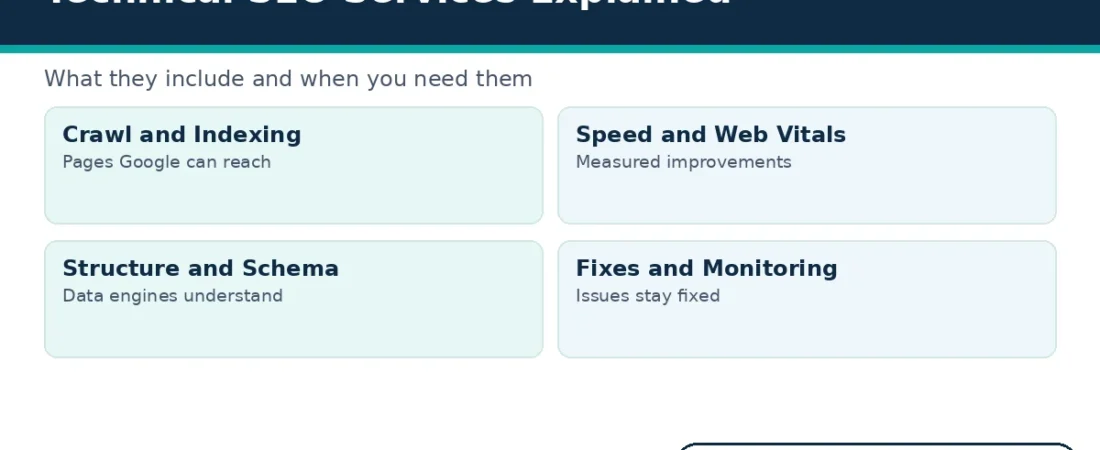
Good technical seo services work through a fixed set of areas. Each area protects a different part of how search engines process your site. Next, here is what each one involves in practice.
Crawl Budget and Indexation
Crawl budget is the time Googlebot spends on your site. Big sites waste it on faceted pages, calendars and old parameters. An audit finds those traps and closes them one by one. Next, indexation checks show which pages Google actually stores. Important pages sometimes sit outside the index for months. The fix list then names each missing page and its cause.
Site Architecture and Internal Paths
Architecture decides how easily crawlers reach your key pages. Deep pages with no internal links often stay undiscovered for months. A technical review maps the structure and flattens the worst paths. It also checks menus, breadcrumbs and pagination settings. Our on-page SEO guide covers what happens inside each page itself.
Core Web Vitals in Plain Terms
Core Web Vitals measure how a page feels to real visitors. Google publishes good thresholds for all three measures. Largest Contentful Paint should finish within 2.5 seconds. Interaction to Next Paint should stay under 200 milliseconds. Also, Cumulative Layout Shift should stay below 0.1. A technical team measures your templates against these lines. Then it finds the scripts, images or fonts pushing pages over them.
Measurement uses two kinds of data. Lab data comes from controlled tests on one device. Field data comes from real visits over the last 28 days. Google judges the field data, so fixes target real visitor experience. A template can pass in the lab and still fail in the field. Similarly, one heavy plugin can slow every page that loads it.
Rendering and JavaScript Issues
Many modern sites build their pages with JavaScript. Google renders that code later, and sometimes it renders incompletely. Menus, links or whole sections can vanish in the rendered version. A rendering check compares the raw and rendered pages side by side. Differences then become concrete tickets for developers, not guesses.
Canonicals, Duplicates and Redirects
Duplicate pages split your signals across several URLs. Canonical tags tell Google which version should count. However, wrong canonicals can point at the wrong page entirely. Redirect chains add delay and waste crawl budget too. A technical pass cleans these routes and tests each one live.
Structured Data and Log File Signals
Structured data helps search engines understand your page content. Valid markup can also unlock rich results in search. A review validates your key templates and fixes the errors it finds. Log files add the final signal. They show exactly which URLs Googlebot visits and how often. Pages that Google never visits rarely rank, whatever their content says.
HTTPS, Status Codes and Server Responses
Every page should load over HTTPS without mixed content warnings. Old HTTP versions then redirect once, straight to the secure version. Status codes need the same care. Missing pages should return a true 404 response. In contrast, soft 404 pages tell visitors one story and Google another. Slow server responses also drag every metric down at once. A technical check tests these basics before deeper work begins.
The table below sums up the main checks and their typical fixes.
Signs You Need Technical SEO Services
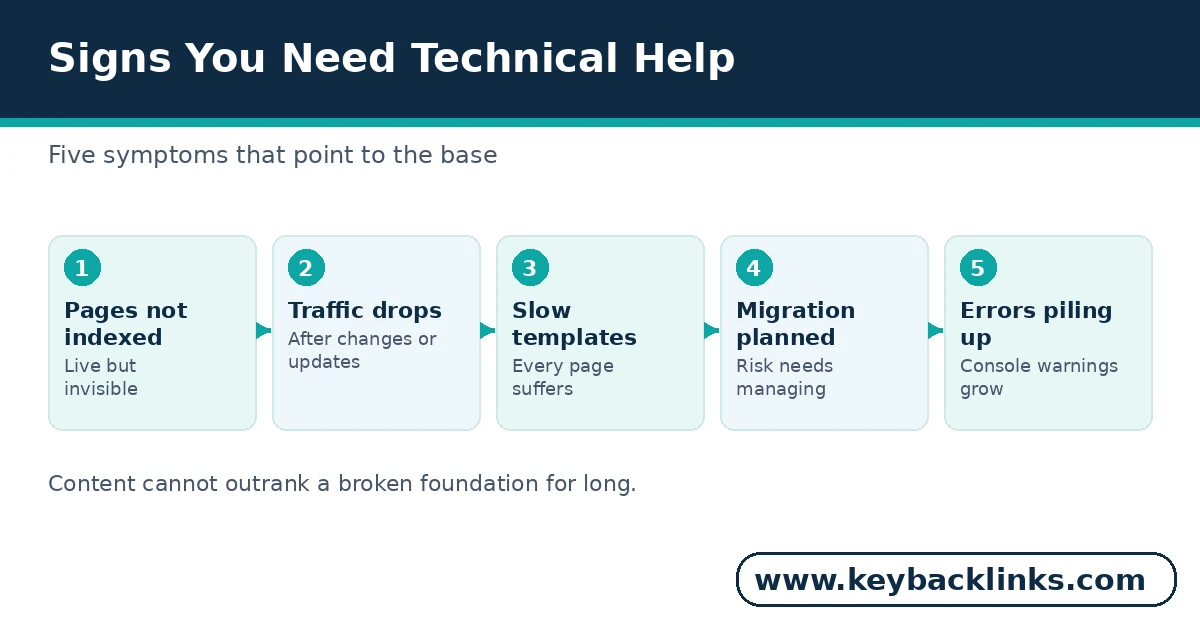
Most sites do not need technical seo services every month. They need help when clear symptoms appear instead. Here are the five patterns that point at the base.
Pages Stay Out of the Index
Your pages are live, but Google never stores them. Search Console shows them as crawled, not indexed, or excluded. So, content work cannot fix that pattern on its own.
Traffic Drops After a Change
Rankings fall right after a redesign, migration or update. A changed setting or broken template usually explains the cliff. A crawl comparison before and after finds it fast.
Every Template Loads Slowly
One slow template repeats across hundreds of pages. Fixing the template lifts the whole group at once. In contrast, guessing at single pages wastes the effort.
A Migration Is on the Roadmap
Domain moves and platform changes carry real ranking risk. Redirect maps and pre-launch checks protect the move properly. Fixing mistakes after launch costs far more time and traffic.
Console Errors Keep Piling Up
Coverage errors grow month after month. Each warning looks small on its own. Overall, they signal a base that nobody currently maintains.
When a symptom matches your site, note when it started. A date beside the symptom speeds up the diagnosis greatly. Then check whether a release, redesign or settings change happened near that date. In short, most technical mysteries become simple once the timeline is clear.
What You Receive From Technical SEO Services
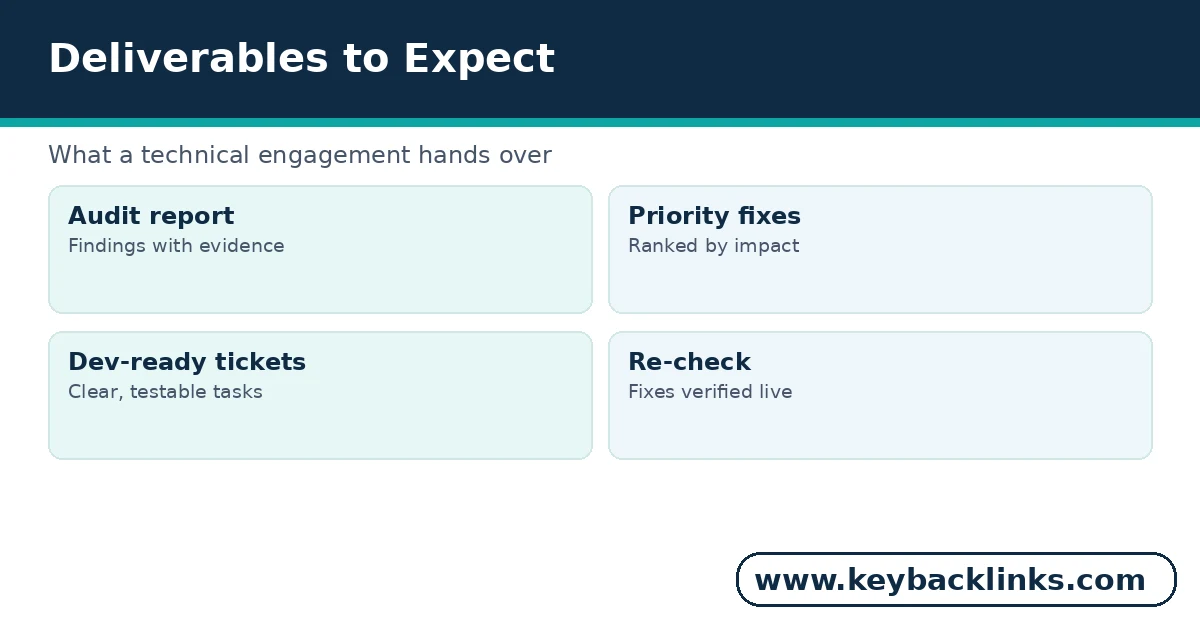
A serious engagement hands over evidence, not a slide deck. First, you receive an audit report with findings and proof. Each finding shows the affected URLs and the data behind it. Next, you receive a ranked fix list. Impact and effort decide the order, not checklist position.
Then the fixes arrive as developer-ready tickets. Each ticket states the change, the template and the test that proves success. Finally, a re-check verifies every fix on the live site. Fixes that fail the re-check go straight back on the list. You also keep the raw crawl data, so a second opinion stays possible.
Example: a strong ticket reads, “Template: product page. Change: preload the main image. Test: LCP under 2.5 seconds on mobile field data.” A weak ticket reads only, “Make the site faster.”
How a Technical SEO Engagement Runs
A full engagement for technical seo services follows four clear stages. First comes a complete crawl and data pull. Then the team writes the report and ranks the fixes. Next, developers ship the fixes in agreed batches. Finally, the re-check confirms each fix on the live site.
Timelines depend on site size and developer access. A small site may finish within weeks. A large store can take a full quarter instead. Above all, judge progress by verified fixes, not by report length.
Who ships the fixes depends on your setup. Some providers hand tickets to your own developers. Others include implementation inside the engagement itself. Either model can work well. However, the re-check must stay independent of whoever wrote the fix. That separation keeps the verification honest.
Monitoring After the Fixes Ship
Technical health decays quietly after launch. New templates, plugins and releases can reopen old problems. Therefore, healthy sites schedule light monitoring after the main fixes. A monthly crawl compares key templates against the fixed baseline. Search Console alerts flag fresh coverage errors early. Then small regressions get fixed while they are still small. This habit costs far less than a second rescue project.
Meanwhile, a simple change log keeps everyone honest. Each release gets one line with its date and scope. Then any new symptom can be matched to a change within minutes. That one habit turns most arguments about cause into quick checks.
Technical SEO Services vs a Technical SEO Audit
An audit is the diagnosis. Technical seo services add the treatment and the follow-up care. The audit tells you what is broken and why it matters. The wider service then implements fixes and monitors the base over time.
On this site, the honest entry point is the audit itself. Our website SEO audit reviews your technical base and returns ranked fixes. Our guide to outsourcing a technical SEO audit explains what to demand from any provider. Start there, then decide how much implementation help you actually need.
Ongoing help earns its fee in specific situations. Frequent releases, large catalogues and planned migrations all justify it. A stable brochure site rarely needs a retainer, though. It needs one clean audit, the fixes, and a yearly re-check. Honest providers say which side your site falls on.
Red Flags When Buying Technical Help
Some offers hide weak work behind vague words. A promise of full optimization, with no sample findings, is one warning sign. Reports without URLs, screenshots or data are another. Also avoid anyone who guarantees fixed positions after technical fixes. Technical work removes barriers to ranking. It cannot guarantee results, because content and links still decide the order. Therefore, ask for one sample finding before you sign anything.
Also check how the provider talks about tools and thresholds. A real specialist names the crawler it uses. It also quotes the published Web Vitals lines without hesitation. Vague answers at this stage predict vague reports later. In short, evidence is the test at every stage of the buying process.
Frequently Asked Questions
What do technical seo services include?
They include crawl and indexation checks, speed work and rendering fixes. They also cover canonical repairs, structured data checks and log file review. Most engagements add a ranked fix list and a final re-check.
How is an audit different from ongoing technical work?
An audit reports what is wrong at one moment in time. Ongoing technical seo services implement the fixes and watch for regressions. Many sites need the audit first, then short bursts of implementation help.
How long do technical fixes take to work?
Google must recrawl the fixed pages first. Small sites often see movement within weeks. Large sites can take months, because crawl visits spread across many URLs. Judge progress by coverage data and template metrics, not single pages.
Can I handle technical SEO myself?
Small sites can cover the basics with Search Console and care. However, migrations, rendering problems and log analysis need specialist tools. An audit shows which side of that line your site sits on. It also stops you paying for help you do not need.
Conclusion
Technical seo services protect everything else you publish. They keep your pages crawlable, fast and correctly indexed. Start with evidence, rank the fixes, and verify each one live.
If your site shows the symptoms above, begin with an audit and a clear fix list. Request a technical SEO quote and tell us which symptoms you see. We will point you at the right first step.