
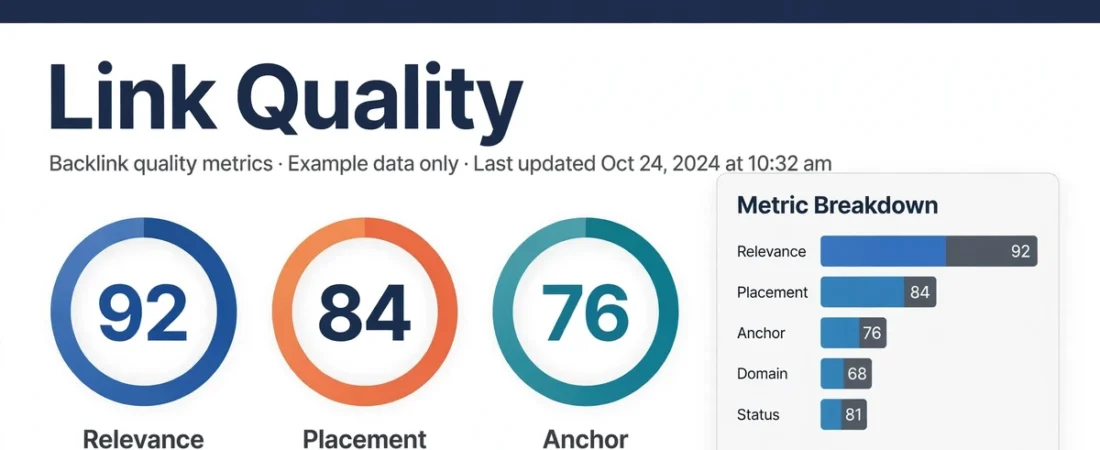
Backlink quality metrics help you judge a link by more than its count. A profile can grow in total links and still get weaker. One strong and relevant link can matter more than many weak ones. Therefore, review each link by clear evidence, not by count alone.
This guide explains the backlink quality metrics that matter most: relevance, placement, and destination, anchor text and link context, and the limits of third-party authority scores, so you do not treat a vendor number as a Google signal.
What Backlink Quality Metrics Measure
Backlink quality metrics describe how useful a link is likely to be. They look at the source page, the link itself, the page it points to, and how the link fits the topic of your page and how a reader would use it.
A good review starts with the source. Ask whether the source page covers a topic close to yours, whether the link sits in the main content, where a reader can see it, and whether the link points to a page that matches the promise of the link text. For a full review process, use the backlink audit checklist alongside this guide.
Relevance Comes First
Relevance is the first test in any review of backlink quality metrics. A link from a page on a close topic is easier to trust. A link from an unrelated page is harder to trust, even if the source site is large. For example, a link to a guide on link building fits well on a page about SEO reporting.
Check relevance at the page level, not only at the site level. A large site can host many topics, and one page can be off topic while the rest is relevant. Therefore, read the source page itself, check its title and the paragraph around the link, and ask whether its readers would find your page useful.
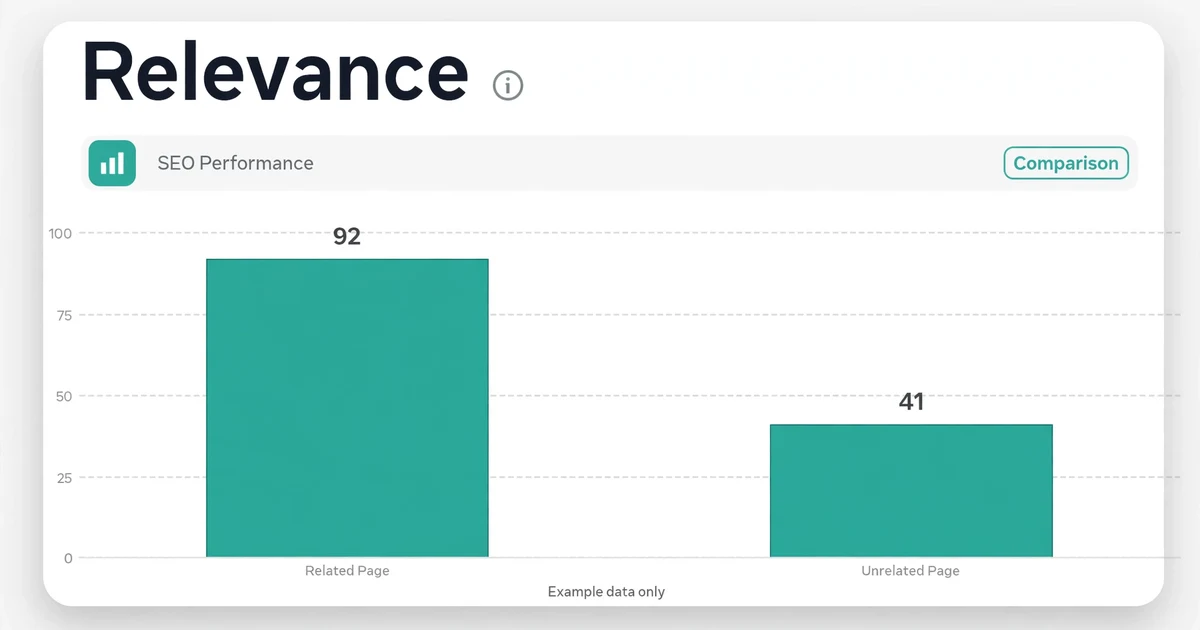
Example chart: relevance scores, related page 92, unrelated page 41. Example data only, not real results.
Placement and Destination Matter
Placement tells you how visible and useful a link is. A link in the main body of an article is easy to find and follow in context. However, a link buried in a footer or a sidebar is harder to notice and harder to trust.
Ask three placement questions for each link. First, can a reader see the link without scrolling through unrelated content? Next, does the text around the link explain why it is there? Then, does the link lead to a live page that matches the link text? A link should point to the most useful page for that reader, not to a home page by default. When a link points to a redirected page, check where it ends.
Anchor Text and Link Context
Anchor text is the clickable text of a link, and it helps readers understand what the destination covers. Natural anchor text is varied: brand names, page titles, short phrases, and plain calls to action. In addition, it matches the topic of the destination page without repeating the same exact phrase on every link.
Watch for patterns, not single anchors. A profile with the same commercial phrase on many links looks unnatural, even if each link comes from a different site. Therefore, review anchors as a group, most common phrases first. Link context is the text around the anchor. A strong link sits in a sentence that explains the topic and gives the reader a clear reason to click. To review anchors in more depth, see our guide on anchor text analysis.
Backlink Quality Metrics: A Comparison Table
Use this table to compare the main backlink quality metrics. It shows what each one tells you, what it cannot tell you, and how to use it.
Example Results: How the Checks Fit Together
The table below shows an example review, not real results.
Third-Party Authority Scores and Their Limits
Third-party authority scores come from SEO tools, not from Google. Each vendor builds its own score from its own link index and its own method. Therefore, two tools can give the same domain very different scores. In addition, a score can rise or fall when a vendor changes its index or method, even when nothing changed on the source site.
Use these scores only as a rough sort, to order a long list so you review the most promising links first. However, do not use a score alone to call a link good or bad. A low score does not prove a link is harmful, and a high score does not prove a link is useful. Always open the source page first. The Ahrefs guide on what makes a high-quality backlink shows how a vendor describes relevance, authority, anchor text, placement, and destination.
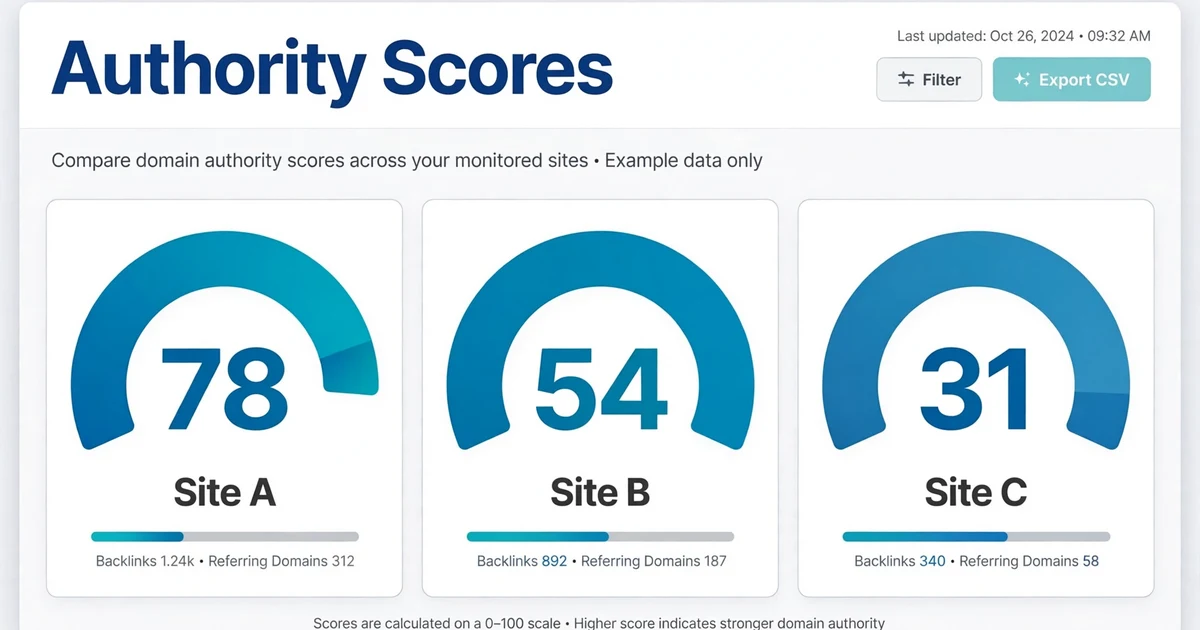
Example chart: authority scores 78, 54, 31 for three example sites. Example data only, not real results.
What to Check and What to Ignore
A useful review of backlink quality metrics separates real signals from noise. Check relevance, placement, destination match, anchor patterns, and the mix of referring domains first. Ignore total link count on its own, a single authority score, and a score change with no link change.
Work through the real signals first, and record a link for a closer look if it fails several checks at once. Do not act on a single weak signal.
Do Not Disavow from a Score Alone
A disavow file tells Google to ignore certain links, and it is a strong action. Therefore, do not use it because a third-party tool gave a link a low score. A score is a vendor estimate, not a Google judgment, and it does not prove that a link is unnatural or harmful.
Only consider a disavow after a manual review. First, open the source page and confirm the link is real. Next, check it against the Google Search Central spam policies, then check for a manual action in Search Console. In most cases, a better first step is to ask the site owner to remove the link.
A Simple Routine for Reviewing Backlink Quality Metrics
Use this routine once a month, or after a large change in your link profile. First, export your current links from the Google Search Console Links report, so your totals stay comparable over time. Next, list the new and lost links since your last review, then sort by referring domain.
After that, review the top links first. For each one, check relevance, placement, destination, and anchor text, and record a short note. Finally, set a follow-up date for any link that needs action. The same routine works across client accounts, as explained in our guide on backlink monitoring for agencies. For a lost link that still matters, our guide on link reclamation explains how to ask for it to be restored.
Common Mistakes in Judging Link Quality
Many reviews go wrong in the same ways. First, some teams judge a link only by its authority score. That shortcut misses relevance and placement, and it can lead to good links being ignored and weak links being kept.
Next, some teams count links instead of reviewing them. A rising total can hide a fall in quality, and many new links from one source do not add the same value as links from varied sources. Therefore, always check the mix of referring domains alongside the total. Another mistake is to act on one link at a time. A single odd anchor is not a pattern, so review the profile as a whole and record each decision with a date and a reason.
Frequently Asked Questions
What are backlink quality metrics?
Backlink quality metrics are the checks you use to judge how useful a link is. They cover relevance, placement, destination, anchor text, and referring domains, plus the limits of third-party scores.
How do I judge a backlink without an authority score?
Open the source page and read it. Check the topic fit, the placement in the main content, and the destination match. If those checks pass, the link is useful, even with no score.
Is a low authority score a bad link?
No, a low score alone does not make a link bad. The source may be new, small, or not yet in a vendor index. Always check relevance, placement, and destination first.
Should I disavow a link with a low score?
No, do not disavow a link from a third-party score alone. First, review the source page against Google spam policies, then check for a manual action in Search Console. Only act after that review, and keep a record of your reasons.
How often should I review backlink quality metrics?
Review them once a month, or after a large change in your profile, a site move, a redesign, or a new content campaign.
Conclusion
Backlink quality metrics work best together. Relevance tells you whether a link fits, placement tells you whether a reader can use it, and destination tells you whether it leads somewhere useful. Third-party scores can help you sort a long list, but they cannot replace a manual review. Record what you check and act only on real evidence.