
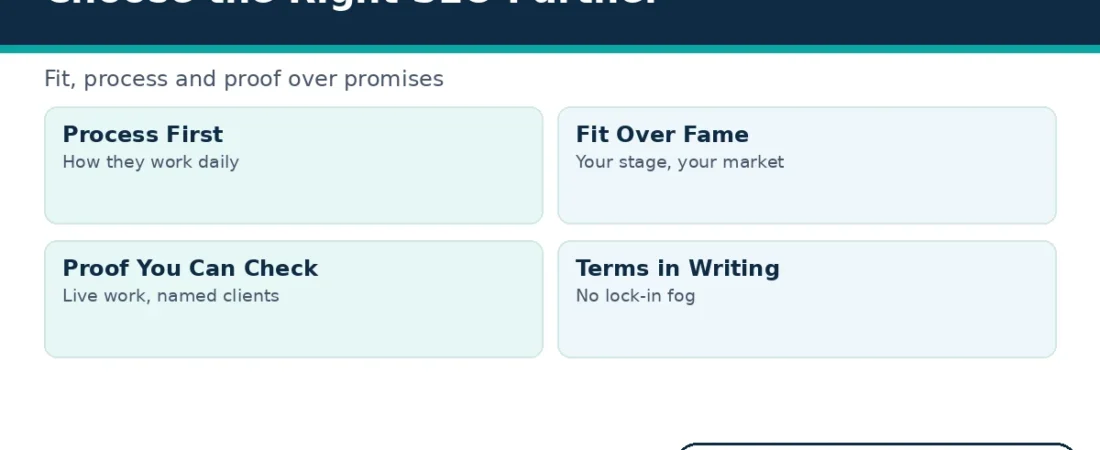
Learning how to choose the right seo partner is one of the biggest decisions a growing business makes. The right choice compounds quietly month after month. The wrong choice drains budget and leaves you with reports nobody can act on.
This guide treats the decision as a partnership choice, not a purchase. First, you will define your stage and the partner shape it needs. Next, you will see the signs of a healthy fit and a simple health check. You will also get a calm onboarding plan for the first ninety days.
Meanwhile, the guide stays practical throughout. Every section ends in something you can check, ask or write down. Partnership quality shows in small daily behaviours long before it shows in rankings.
Partner vs Vendor: What the Word Should Mean
A vendor sells tasks. You order ten articles or twenty links, and the vendor delivers a count. A partner, in contrast, shares responsibility for outcomes and explains every trade-off in plain language.
The difference shows up in hard moments. A vendor hides a traffic drop inside a cheerful chart. A partner flags the drop early, explains the likely cause and proposes a fix before you even ask.
Partnership also means shared access and shared credit. Your partner works inside your accounts, not inside a black box. Therefore, you can see the work, question the work and keep the work if the relationship ever ends.
Knowing this difference helps you choose the right seo partner instead of buying a task list. The sections below turn that idea into checks you can actually run.
For example, watch how a provider handles one awkward question during your first calls. Ask what they would stop doing on a site like yours. A vendor dodges, because stopping sounds like selling less. A partner answers gladly, because focus is the whole point of the role.
Know Your Stage Before You Choose the Right SEO Partner
Every site sits at a different stage, and each stage needs a different partner shape. A mismatch here causes most failed engagements, so define your stage honestly first. You choose the right seo partner for the stage you are in, not the stage you wish you were in.
A New Site Needs a Builder
A new site needs foundations first. Your partner should prioritise technical health, clean structure and a small set of strong pages. Grand link campaigns can wait until the basics earn trust.
Builders also set expectations gently. Early growth is slow and uneven, and a builder explains that pattern before it worries you.
A Growing Site Needs a Scaler
A growing site already wins some traffic and enquiries. Your partner should find the near wins, expand what works and protect what already ranks. Momentum matters more than novelty at this stage.
Scalers also watch capacity honestly. They tell you when content, development or budget limits the plan, instead of promising work nobody can deliver.
A Stuck Site Needs a Diagnostician
A stuck site has history, baggage and flat charts. Your partner should audit first, explain the blockers and fix causes instead of adding more content. Fresh activity on a broken base simply wastes money.
Diagnosticians earn trust with evidence. They show you the problem, the proof and the repair order before they ask for a bigger budget.
In short, the same provider can be wrong for one stage and perfect for another. Fit beats fame, and stage beats size.
Four Signs You Found the Right Partner
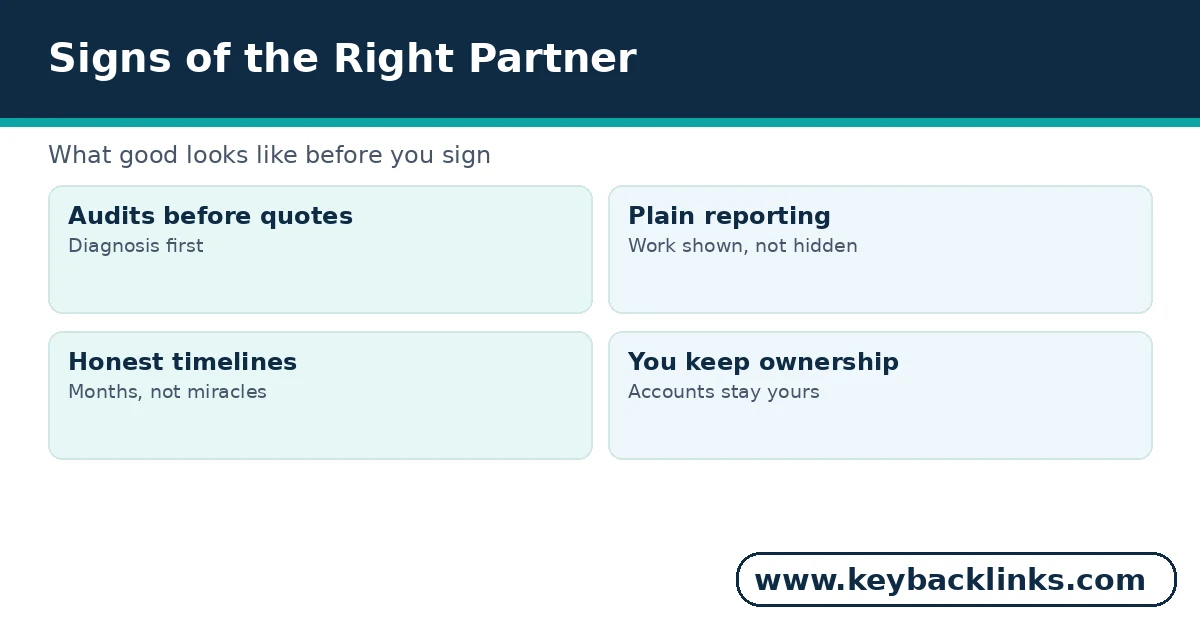
Four signs separate a real partner from a polished sales pitch. Look for all four before you sign anything, because each one predicts your daily experience later.
Audits Come Before Quotes
A good partner studies your site before naming any work. The audit reveals your stage, your blockers and your quickest wins. A quote written before that study is only a guess dressed as a plan.
Reporting Stays Plain
Reports should show work done, results seen and next steps planned. You should understand every line without a glossary. If a report needs a sales call to decode it, the report serves the seller, not you.
Timelines Stay Honest
SEO compounds over months, and honest partners say so. They give ranges, name the risks and explain what could slow progress. Anyone who promises page one by a fixed date sells certainty they do not own.
You Keep Ownership
Your accounts, your data and your content stay yours. The partner works as a guest inside your analytics and Search Console. If the engagement ends, everything stays with you, including the full history.
Together, these four signs predict the daily experience of the relationship. Use them as a filter, and you will choose the right seo partner with far less guesswork.
How a Good Engagement Is Structured
A healthy engagement follows a simple rhythm. It starts with diagnosis, moves into a written plan and then settles into steady monthly work. Quarterly reviews reset priorities as results and markets change.
Diagnosis comes first. Your partner audits the site, studies your competitors and interviews you about margins and goals. Google offers similar advice in its SEO Starter Guide, which explains what to expect when you hire an SEO.
The plan then names a few priorities per quarter, not thirty scattered tasks. Each priority carries an owner, a reason and a measure. Monthly work executes the plan, and the monthly report compares results against it.
Finally, the quarterly review asks harder questions. Which bets paid off, which stalled and what changes next quarter. This rhythm keeps strategy alive instead of letting it fossilize in a kickoff deck.
Between reports, the rhythm stays light but steady. A shared task list shows what is live, what is waiting and what needs your input. Short check-ins clear blockers early, so the monthly report never carries stale surprises.
Structure like this makes it far easier to choose the right seo partner and keep the relationship healthy. Both sides know what happens next, and surprises stay rare.
The Price Conversation, Handled Honestly
Price matters, but price only makes sense beside scope. Providers usually charge by the hour, by monthly retainer, by project or by package. Each model suits a different stage and a different appetite for control.
Instead of hunting the lowest number, ask what the number includes. Diagnosis, content, links, reporting and meetings all cost time. A cheap quote often hides thin work in one of those areas.
Two companion guides on this site go deeper on comparison. Our scoring framework for SEO companies helps you compare providers side by side with one fair rubric. Our interview questions guide lists the questions that reveal how a provider really works. Use both before the price call, and the numbers will mean more.
Also read the exit terms before you sign. A fair contract states notice periods, handover duties and what happens to content and data. A partner who explains exit terms calmly expects to earn your renewal, not trap it.
Above all, a partner explains price drivers calmly. Site size, competition and starting point move the cost, and an honest partner shows you how. A calm, specific price talk is one more way to choose the right seo partner with confidence.
Five Onboarding Steps After You Choose the Right SEO Partner
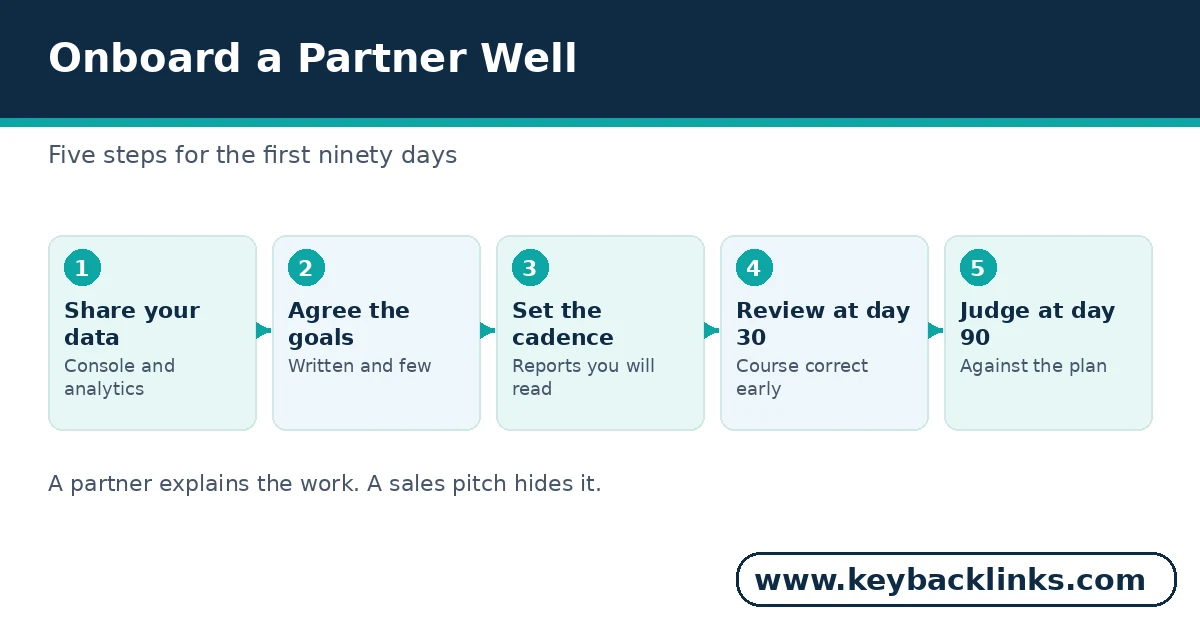
Signing is only the midpoint. The first ninety days decide whether the partnership feels smooth or strained, so onboard with the same care you used to choose.
Step One: Share Your Data
Give your partner access to analytics, Search Console and your content tools from day one. Shared data ends arguments about whose numbers are right. It also lets the partner spot quick wins in the first weeks.
Step Two: Agree a Few Written Goals
Write down three to five goals for the first quarter. Keep them specific, such as more enquiries from service pages or recovery on a key category. A short written list beats a long vague wish.
Step Three: Set the Reporting Cadence
Agree when reports arrive, what they contain and who joins the review call. A monthly report with a short call suits most businesses. The cadence matters more than the template.
Step Four: Review at Day 30
The day-30 review corrects course early. Check access, priorities and communication while everything is still easy to change. Small fixes now prevent big frustrations later.
Step Five: Judge at Day 90 Against the Plan
At day ninety, judge the work against the written plan, not against hope. Look for completed priorities, honest reporting and early movement on target pages. Then renew, adjust or part ways with clear eyes.
This rhythm turns a hopeful signature into a working partnership. It also gives you fair evidence if you ever need to change providers.
The Partnership Health Check
After signing, run this simple health check every quarter. It shows whether the partnership still serves your goals, and it starts conversations before small issues grow teeth.
A healthy result across all four areas means the relationship deserves more time. Two warning signs in one quarter mean a direct conversation, not silent patience. Run the check honestly, and you will know whether you did choose the right seo partner.
Run the check yourself rather than asking the partner to grade the work. Your view of clarity, speed and honesty is the view that matters. Then share the result openly, because a good partner would rather hear a concern in month three than a cancellation in month six.
Red Flags Inside a Partnership
Some problems only appear after the contract starts. Watch for these three patterns during the first months, because early patterns rarely fix themselves.
You Cannot Reach the People Doing the Work
A partner introduces the specialists on your account and lets you speak with them. If every question routes through an account manager who cannot answer it, knowledge stays hidden. Hidden knowledge usually hides thin work too.
Reports You Cannot Understand
Confusing reports protect the provider, not the client. Charts without work lists, jargon without explanations and metrics without decisions all signal trouble. Ask for plain language once; if the fog returns, treat it as an answer.
Everything Becomes an Urgent Upsell
Real partners raise extra work when evidence supports it, with calm timing. Constant urgency is a sales tactic, not a strategy. Each upsell should arrive with data, a reason and clear permission to say no.
None of these flags needs a dramatic exit on day one. Raise the concern, watch the response and let the response guide you. A good partner fixes the pattern; a vendor defends it.
Where a Specialist Like KeyBacklinks Fits
Many businesses pair an in-house marketer or a general agency with a specialist for one hard area. Link building is the classic example, because outreach, quality checks and reporting take steady weekly effort.
KeyBacklinks works in exactly that slot. We build links and authority for sites whose content and technical base are handled by your own team or another partner. Our services page lists the work we cover, from guest posting to niche edits.
Coordination keeps this arrangement clean. Your lead marketer or agency sets the overall priorities, and the specialist plans link targets inside them. Anchor choices, target pages and timing get agreed up front, so two teams never chase the same page with different ideas.
A specialist should strengthen the wider setup, not compete with it. We share plans, respect your existing priorities and report in the same plain style this guide describes. Choosing specialists role by role is often the calmest way to choose the right seo partner setup for your business.
Frequently Asked Questions
How do I know I managed to choose the right seo partner?
Check the relationship at day ninety against your written plan. Completed priorities, plain reports and honest conversations about setbacks all point to a good fit. If the health check above stays green for two quarters, you chose well.
How long should a first SEO contract run?
Three to six months suits a first engagement. That window covers diagnosis, the first plan and at least one full review cycle. Longer lock-ins before any proof shift all the risk onto you.
What should I hand over at the start?
Hand over access, context and candour. Your partner needs analytics and Search Console access, your margins and priorities, and an honest history of past work. Surprises about old penalties or bought links help nobody.
When should I change SEO partners?
Change when warning signs survive a direct conversation. One bad month is weather; a repeated pattern is climate. Use the day-90 review and the health check as your evidence, then move calmly with your data intact.
Conclusion
To choose the right seo partner, look past the pitch and study the relationship on offer. Check your stage, demand an audit before a quote and insist on plain reporting and full ownership.
Then onboard with shared data, written goals and fixed review points. If you want a specialist partner for link building inside that setup, request a link building quote. Tell us about your site, your stage and your goals, and we will reply with a clear first step.