
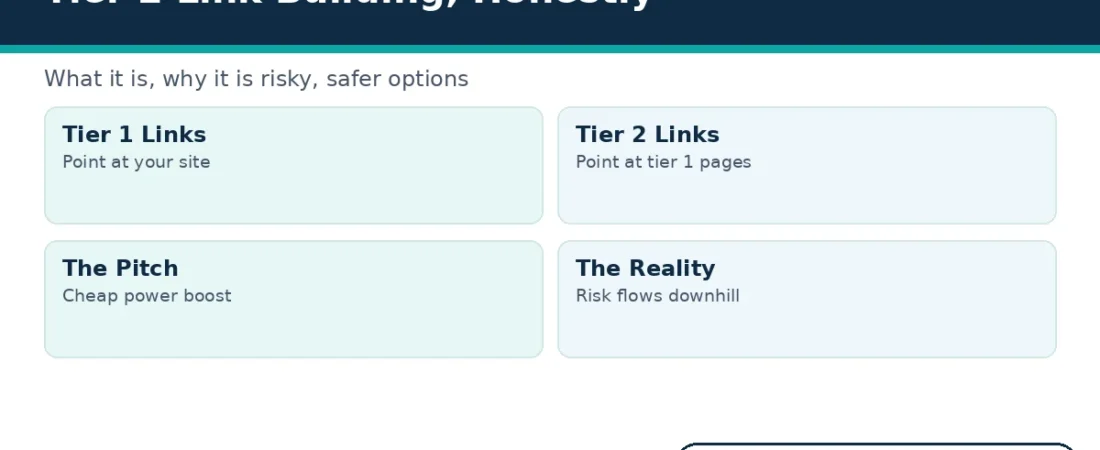
Tier 2 link building is the practice of building links to pages that already link to your site. Sellers present it as a shortcut that makes your existing links stronger. This guide explains what the tactic involves, what Google actually says about it, and which safer options reach the same goal.
However, the short answer comes first. Tiered link building of this kind sits squarely inside Google’s definition of link spam. The tier label changes nothing about that risk. Below, you will see the mechanics, the warning signs and the alternatives that hold up over time.
One point of scope matters as well. This article explains the tactic honestly, because buyers deserve clear information before they spend money. KeyBacklinks does not sell tiered link building, and nothing in this guide recommends it.
What Tier 2 Link Building Actually Means
Start with the basic structure. A tier 1 link points directly at your website. For example, a guest post on a partner blog links to your services page. That guest post then becomes your tier 1 asset.
Tier 2 link building adds a second layer behind that asset. Instead of linking to your site, the new links point at the guest post itself. The idea is simple: a stronger guest post should pass more value through its link to you.
The jargon also includes a tier 3. Tier 3 links point at the tier 2 pages and add yet another layer. Each layer moves the links further from your site, but it never moves them outside Google’s rules.
Next, walk through one concrete example. A bakery pays for a guest post on a food blog, and that post links to its wedding cakes page. Then the bakery buys two hundred cheap links that point at the guest post. The guest post is tier 1, and the two hundred links form tier 2.
How Tier 2 Packages Are Usually Built
Most packages draw from the same cheap link sources. Web 2.0 posts on free blogging platforms form the base of many offers. Forum profiles, blog comments and article directory links fill out the rest.
Some packages add low cost guest posts on sites that accept almost anything. These sites publish thin content across unrelated topics, and they sell placements openly. A quick read of a few sample posts usually reveals the model within minutes.
None of these sources is automatically a problem on its own. A single forum profile or directory listing harms nobody. The problem starts with scale and intent: hundreds of them, bought together and built to push rankings.
Why People Buy Tier 2 Link Building
The sales pitch sounds logical at first. Your guest post already links to you, so why not make that post more powerful? Sellers promise that cheap supporting links will push the post upward, and your site will rise with it.
Price drives most of the appeal. Tier 2 packages often advertise hundreds of links for a very low fee. By comparison, earning one genuine editorial link takes outreach, writing and patience.
Speed adds to the temptation. A blast of supporting links can go live within days. Real promotion rarely moves that fast, so impatient buyers reach for the shortcut.
Sellers also package the tactic to sound engineered and safe. Names like link wheels, link pyramids and authority stacking dress up the same basic structure. The diagrams look scientific, yet the underlying links remain bought links built to manipulate rankings.
What Google’s Spam Policies Say About Tier 2 Link Building
Google’s rules do not mention tiers at all. Instead, its spam policies define link spam by intent and effect. Links created mainly to manipulate rankings fall under that definition, wherever they point.
The policy covers buying or selling links that pass ranking value. It also covers link schemes, excessive link exchanges and automated link creation. Google sets out the full list in its spam policies documentation.
Crucially, the policy judges the purpose of a link, not its distance from your site. A bought link that points at your guest post still exists to lift your rankings. Therefore, the extra layer does not launder the link into something safe.
Paid placements also need honest labelling. Any link that exists because money changed hands must carry rel=”sponsored” or rel=”nofollow”. Tier 2 packages almost never apply those labels, because the whole pitch depends on passing value.
Labels are not a technicality. A paid link marked as sponsored works like an advert: it can send visitors, but it passes no ranking credit. Sellers skip the labels precisely because labelled links would not deliver the promised boost.
Enforcement does not rely on manual reviews alone. Google runs spam updates that improve how its systems detect link spam at scale. Therefore, a pattern that survives today can lose its effect, or draw action, after the next update.
How the Risk Travels Back to Your Site
Some buyers assume that distance equals safety. In practice, the pattern is easy to see. Any backlink tool can map the links that point at your guest post, and the chain back to your site takes seconds to trace.
Risk then flows along that chain. If Google decides the supporting links are spam, it can discount the guest post or act against the wider pattern. Your page sits at the end of that pattern, so the exposure reaches you directly.
The outcome is not always a formal penalty. Often, Google simply discounts the manipulative links, so the money buys nothing at all. In worse cases, a manual action can remove pages from results until you clean up and request reconsideration.
You also control almost nothing in the chain. The site owner can edit the guest post, remove your link or delete the page entirely. Meanwhile, the seller can vanish, leaving links you cannot remove inside a profile you did not build.
Your tier 1 asset can also become a liability for its owner. If the host site spots a spammy pattern pointing at your guest post, its owner may strip the post or add a nofollow tag. Either move quietly erases the value you paid to build.
Judging which links in that chain look unnatural takes care. Our backlink quality metrics guide shows the relevance, placement and anchor checks that reveal a manufactured pattern.
Warning Signs of a Tier 2 Scheme
Most tier 2 link building offers share the same fingerprints. The diagram below collects the clearest ones, so you can spot the pitch quickly.
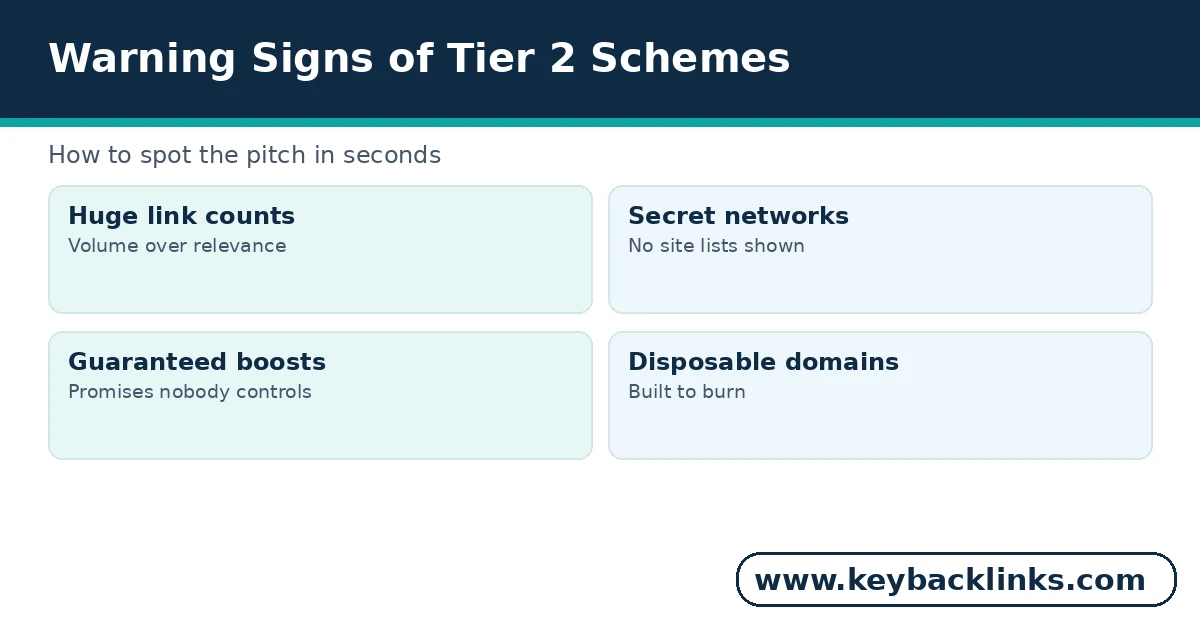
Volume promises lead the list. A seller who leads with link counts cares about quantity, not fit. Secret networks come next, because an honest provider can show you the sites involved.
Guaranteed boosts are another clear signal. Nobody outside Google controls rankings, so nobody can promise them honestly. Finally, disposable domains reveal the model itself: sites built to burn have nothing to lose, but your site does.
One question cuts through most pitches. Ask the seller for the full list of sites before you pay. A legitimate provider shares samples and explains each placement. A scheme seller refuses, because the list itself would end the conversation.
Safer Alternatives to Tier 2 Link Building
The goal behind the tactic is legitimate. You want a strong page to pass more value to your site. Fortunately, five safer routes reach that goal without the spam exposure.
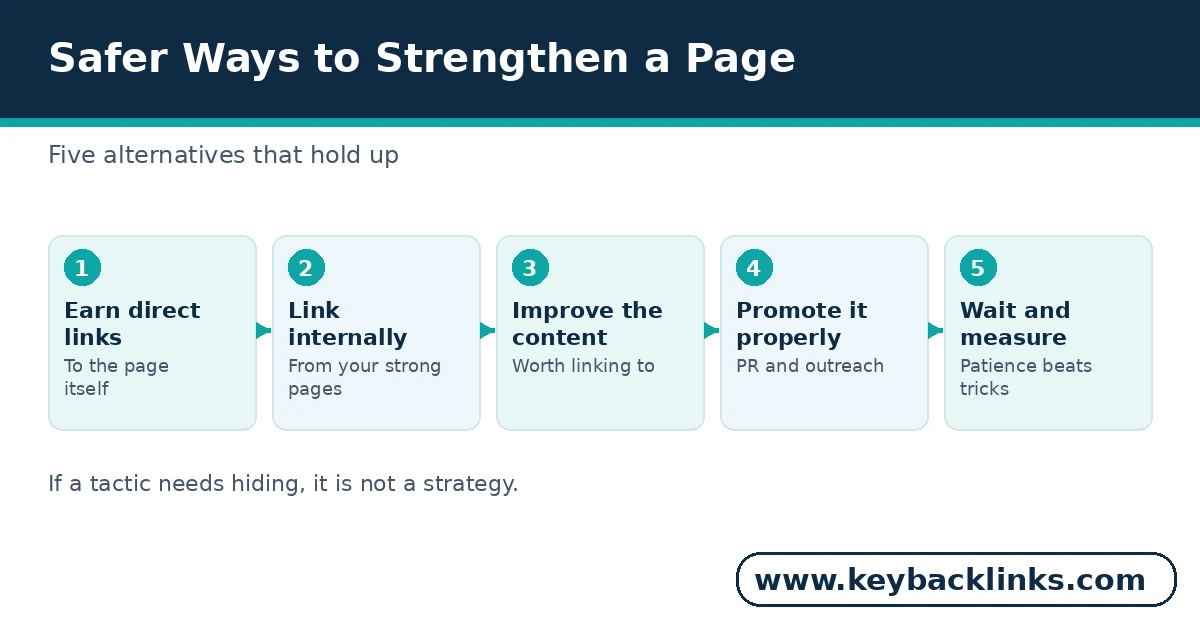
You can combine these routes in any order. Most sites start with internal links, because they cost nothing and work today. Then they improve the page, and only then spend effort on outreach with something worth promoting.
Moreover, each route strengthens assets you fully control. Internal links stay live as long as your site does. Better content keeps earning links long after you publish it. In contrast, a rented chain of scheme links can collapse overnight, usually without any warning.
Earn Links Directly to the Page
The simplest fix is to skip the extra layer. Outreach that earns links straight to your money page builds value you actually own. Each new referring domain strengthens your site directly, with no fragile chain in between.
Strengthen It With Internal Links
Internal links sit fully under your control. Link to the target page from your strongest relevant articles, and use natural anchor text. This passes real value immediately, and no policy risk attaches to it.
Improve the Content Itself
Pages earn links when they deserve them. Add original data, clearer examples or a useful tool, and the page becomes easier to promote. Better content also converts the visitors your existing links already send.
Promote It Properly
Real promotion means digital PR, partnerships and genuine outreach to relevant editors. Our link building strategies guide explains how these methods build links that survive scrutiny. The work is slower, yet every link earned this way is an asset, not a liability.
Wait and Measure
Finally, give good links time to work. Rankings respond over weeks and months, not days. Measure referring domains and Search Console trends before you spend more, because patience often replaces the purchase entirely.
Why Some People Still Choose It
Honesty also means describing the other side fairly. Some buyers use throwaway sites or short term projects where long term risk matters less to them. Others simply never read the policy and trust the seller’s framing instead.
Those reasons explain the market, but they do not change the maths for a real business. If your site earns revenue and must still rank next year, the exposure outweighs the shortcut. This guide therefore describes the tactic plainly, without recommending it.
Agencies also resell these packages to clients who never see the mechanics. The client receives a report full of links and a short term bump, while the risk stays hidden. By the time rankings fall, the contract has often ended.
Comparing the Options Side by Side
The table below sums up the choice. It compares the two common tier 2 products with the safer routes covered above.
If You Already Bought Tier 2 Links
If this tactic already sits in your profile, stay calm and work in order. First, list the tier 1 pages involved and the links that support them. Then judge each chain against the quality checks above.
Where the pattern looks manufactured, act on it. Our how to remove bad backlinks guide explains removal requests, cleanup order and when disavowal actually makes sense. Document what you remove, so future audits can see the change.
Above all, do not buy more links to fix a link problem. Stop the inflow first, clean the obvious schemes, and rebuild with the safer alternatives instead.
Set honest expectations for the cleanup itself. Removing links takes weeks, because you depend on site owners replying to your requests. Algorithmic recovery then follows Google’s own schedule, so judge progress across months, not days.
How KeyBacklinks Works Instead
KeyBacklinks builds links the slower, defensible way. We research relevant sites, agree placements openly and report every live URL. Paid placements carry correct labels, and anchors stay natural throughout.
That approach will never match a blast on raw link counts. However, each link is one you can show a customer, an auditor or Google without concern. If you want that kind of plan, request a link building plan and tell us about your site and your goals.
Furthermore, we will tell you plainly when a page needs fixing before any links make sense. Honest advice at the start costs far less than cleanup later.
Frequently Asked Questions
Is tier 2 link building safe?
No. Tier 2 link building carries the same link spam exposure as buying links directly, because Google judges the intent behind the links. The extra layer hides nothing from its systems or from backlink tools.
Can tiered links move rankings at all?
Manipulative links can appear to work for a while, which is exactly why the market exists. However, the effect rests on links that Google may discount or act on at any update. Any gain therefore carries a built-in expiry risk.
Can Google detect links two layers away?
Yes, in practical terms. Google crawls links between pages continuously, and third party tools map the same chains in public. Distance adds steps to the map, but it does not erase the pattern.
What should I do instead of buying tier 2 links?
Earn links directly to the page, strengthen it with internal links, and improve the content so promotion gets easier. Those steps build value on pages you control. None of them breaches the spam policies.
Conclusion
Tiered link building sells a simple promise: cheap power, pointed at pages you already have. The catch is structural. Google judges links by intent, not by distance, so the scheme’s exposure reaches your site through every layer.
Choose the slower route instead. Earn direct links, link internally with care, and improve the pages that matter most. That work compounds quietly over time, and it never needs hiding from anyone.