
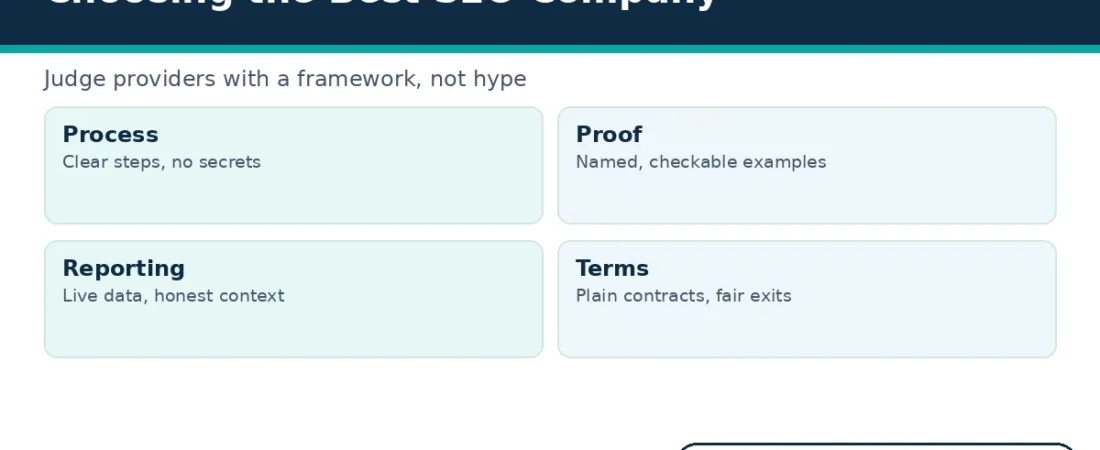
Finding the best seo company in usa is harder than the search results suggest. Almost every agency claims the top spot for itself. Most ranking lists simply repeat the same familiar names. This guide takes a different route. It hands you a scoring framework, so you can judge any provider with the same fair tests.
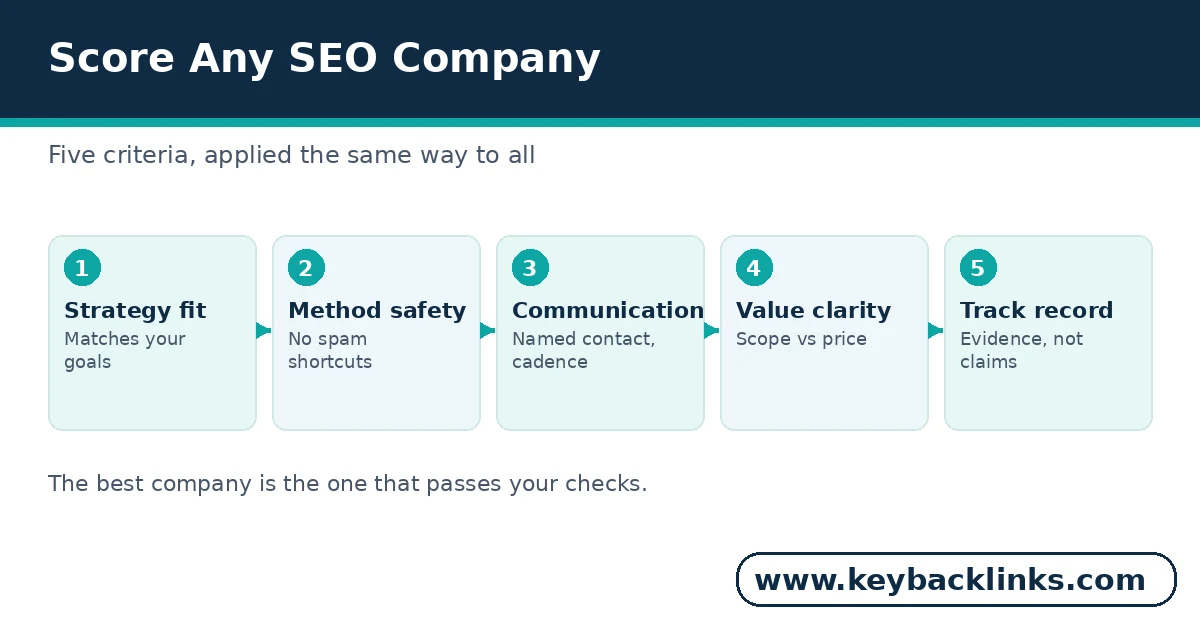
The framework rests on five criteria. They are strategy fit, method safety, communication, value clarity and track record. You score each criterion, and then you add the scores into one total. Therefore, you compare evidence instead of sales polish.
First, a note on scope. Our companion guide to the best SEO services in the USA explains what each service type actually does. This article skips that ground on purpose. Instead, it focuses only on judgement: how you spot a strong provider, and how you avoid a risky one.
You can use the framework on any shortlist. It suits a local firm, a national agency or a small specialist team. Above all, it works before money changes hands, while you can still walk away at no cost. In short, the best seo company in usa for your business is the one that passes your tests, not the one with the loudest badge.
This guide suits owners, managers and in-house marketers alike. You may run a local service firm, an online store or a growing national brand. The criteria stay the same across those cases. Only the evidence behind each score changes. By the end, you will hold a rubric, a worked example and a call script. Together, they turn a vague search into a calm, repeatable decision.
Why “Best” Lists Mislead Buyers
Most best company lists are marketing assets, not research. Some charge agencies for placement on the list. Others earn a fee when you click through and sign up. Almost none of them test the work they praise.
Also, the lists rarely ask who the ranking serves. The best seo company in usa for a national retailer differs from the best choice for a local law firm. Budget, market and goals change the answer completely. A single ranked list cannot hold all three answers at once.
For example, one list may reward the agency with the largest ad budget. Another may copy a rival list and shuffle the order. Neither method tells you how the agency will treat your site.
Lists also age badly. A strong agency can lose its best staff within a year. A weak agency can rebuild and improve quietly. Printed rankings freeze both pictures in place, while your decision needs the current one.
Therefore, treat every list as a source of names only. Then run your own checks on each name before you talk price. The checks below take under an hour per provider. However, they reveal more than any badge, award or five star graphic.
Finally, remember who writes the list. When the author also sells SEO, the ranking serves the author first. Your own scoring serves you instead.
The economics explain the pattern. Many lists earn money when you click, call or sign up through them. Therefore, the ranking follows the fee, not the quality of the work. A provider can even pay for a higher slot on some lists. None of that research touches your site, your market or your goals.
What a List Can Still Do for You
Still, lists have one honest use. They widen your pool of names at the start. Collect three or four candidates from any source you trust. Then discard the list itself and score every name from zero. That habit keeps marketing out of your final decision.
The Five Criteria That Define the Best SEO Company in USA
Five criteria cover almost every way an SEO provider can help or harm you. Score each one out of its weight, using the rubric in the next section. Then add the five scores for a total out of one hundred.
A total above seventy marks a serious candidate for the best seo company in usa title on your own list. A total below fifty should end the talks, however warm the sales call felt. Between those marks, the detail decides.
Also, score with evidence, not impressions. Ask for the document, the sample or the live link behind each claim. Then write the score down while the evidence sits in front of you.
Evidence gathering comes before scoring. Ask each provider for the same five items. Request a sample report, a written method summary and a sample content piece. Also ask for two checkable examples of past work. Finally, ask for the standard contract before the sales call ends. Providers who send these items quickly usually work openly. Providers who stall usually hide weak processes behind that delay. Score only what you can see, and mark missing evidence as a low score.
Criterion 1: Strategy Fit (Worth 25 Points)
Strategy fit asks one simple question. Does this provider build its plan around your goals, or around its own package list? A fitting provider studies your market before it names a single task.
Good signs appear early. The team asks about your customers, your margins and your priority pages. It audits your site before it quotes. Then it ties each task to a goal you recognize.
Warning signs appear early too. The provider sells the same package to every caller. It quotes a price before it opens your site. In contrast, real strategy starts with questions, not with a price list.
For example, a local firm needs map visibility and reviews more than national content. A provider that leads with a national link package has not listened. Score that mismatch honestly.
Also, check how the plan handles your stage of growth. A new site needs foundations and patience. An established site may need depth and authority instead. The plan should name your stage out loud.
You can test fit inside the proposal itself. A fitting proposal names your pages, your rivals and your goals in its first section. It also explains why each task comes before the next one. In contrast, a generic proposal could serve any business in any town. When the document never mentions your market, the plan behind it will not either.
Criterion 2: Method Safety (Worth 25 Points)
Method safety protects your site from shortcuts that cause lasting harm. A safe provider explains every method in plain language. It also welcomes your questions about how links and content get built.
Google publishes its expectations openly. The SEO starter guide sets out the basics that help search engines understand a site. A safe provider works inside that spirit. It never needs to hide a tactic from you or from Google.
Safe link work has clear habits. Links sit inside relevant content on real sites. Paid placements carry the correct sponsored or nofollow labels. Anchors read naturally, like brand names and plain descriptions.
Unsafe work hides behind fog. Secret methods, private networks and automated link blasts all belong in that fog. Above all, guaranteed first page rankings signal danger, because nobody controls Google results.
Ask one direct question here. Ask what the provider refuses to do. A safe team answers at once, with a named list of banned tactics. A risky team changes the subject.
Content methods deserve the same scrutiny. Ask how the team writes and who edits the work. Careful teams research your customers, then draft and review each page. Risky teams publish scaled, thin content that adds pages without value. Also ask how the provider labels paid placements. The honest answer names the sponsored or nofollow attribute at once. Vague answers here predict trouble later.
Criterion 3: Communication (Worth 15 Points)
Communication decides how the work feels month after month. You need one named contact who knows your account. You also need a fixed rhythm for updates and reports.
Good communication sounds plain. Reports explain what changed, why it changed and what happens next. Bad news arrives early, with a plan attached. Questions get answers within a stated time frame.
Poor communication hides behind jargon. Vague monthly summaries list tasks without results. Contacts rotate so often that nobody owns your history. In short, you pay for work you cannot follow.
Test this criterion during the sales stage. Send one detailed email before you sign. Then judge the reply for clarity, speed and honesty. That reply previews the whole relationship.
Ask for the reporting rhythm in writing. Strong providers fix a monthly report date and a regular call. They also state who writes the report and who answers your questions. Then check the sample report for plain language. When a sample needs a dictionary, the real reports will waste your time every month. Clear writing signals clear thinking behind the work.
Criterion 4: Value Clarity (Worth 20 Points)
Value clarity means you can see what your money buys. A clear provider itemizes its scope in writing. Each task has a quantity, a schedule and an owner.
Published packages help a great deal here. They show service levels and prices before any sales call. Therefore, you can compare scope against price across providers on equal terms.
Hazy value looks different. One line on an invoice covers a month of work. Discounts appear without any change in scope. Extra charges surface only after you ask hard questions.
Also, check what the price excludes. Content, links and technical fixes often sit in separate buckets. A low headline price may cover only one of the three. Score the full cost, not the headline.
A simple exercise exposes hazy value fast. Take two proposals and list every task each one includes. Then match the lists line by line, task against task. Gaps appear at once: one price covers links, while the other covers only audits. Also note the limits inside each task, such as page counts or link counts. Only then does the cheaper offer show its true shape.
Criterion 5: Track Record (Worth 15 Points)
Track record asks for proof that survives a phone call. Strong providers share checkable examples of past work. They name the client type, the task and the outcome in plain terms.
Live evidence beats polished graphics. Ask for sample pages, published articles and live links. Then open them yourself and read them like a customer. Real work withstands that simple test easily.
Weak proof dodges every check. Screenshots appear without dates or site names. Famous logos appear without any story behind them. References stay unavailable for privacy reasons that never end.
However, judge the proof fairly. Small providers may show fewer examples, yet still work with real care. Score the honesty and checkability of the proof, not its volume.
References give you the strongest check of all. Ask for two clients you may contact directly. Then ask those clients about reporting, honesty and problem handling. Satisfied clients describe specific work and specific people. In contrast, coached references repeat slogans without detail. Also ask how long each client stayed. Long relationships suggest steady value, while rapid churn suggests the opposite.
Scoring the Best SEO Company in USA: The Rubric
The table below fixes the weights, so every provider faces the same test. Print it before your calls. Then fill one copy per provider while the evidence sits in front of you.
Close scores need a tie breaker. When two providers finish within five points, revisit method safety first. Safety failures cause lasting harm, while other gaps can improve over time. Then compare the contract terms side by side. The safer provider with the fairer exit clause deserves the signature.
A Worked Example With Two Fictional Providers
The two profiles below are fictional examples. We invented both companies, both histories and both scores to show the method. No real business is judged, scored or ranked anywhere in this section.
Provider A is Bright Path Digital, a fictional mid size agency. Its team audits your site before quoting. It publishes its packages and its methods on its own site. Its reports list live URLs, dates and next steps.
Provider B is Rank Rocket Media, a fictional low cost firm. It promises first page rankings within ninety days. Its methods stay proprietary during every call. Its reports show only charts, without a single live link.
Now score both firms with the rubric. Bright Path loses points on track record, because its public examples stay modest. Rank Rocket gains a fair communication score, because its small team replies fast. However, its hidden extras weaken its value score on inspection.
The Scores, Side by Side
The totals tell a clear story. Bright Path passes the seventy mark and earns a contract discussion. Rank Rocket falls below fifty, so the talks should end politely. Neither firm won because a list called it the best seo company in usa. The evidence decided instead.
Notice where Rank Rocket scored well. Its small team replied quickly, so its communication score beat Bright Path. One strong criterion, however, cannot rescue a failing whole. Method safety carries a heavy weight for a reason. Unsafe links can harm your site long after the contract ends.
Bright Path also shows a fair weakness. Its track record score leaves room to grow, so a careful buyer asks for more examples. The agency can answer with live pages and a reference call. If it refuses, its score drops and the decision may flip. The framework therefore rewards honesty on both sides of the table.
Questions to Ask on the First Call
Scores start with answers, and answers start with questions. When you hunt for the best seo company in usa, ask each shortlisted provider the same set. Then the replies stay comparable across your whole shortlist.
First, ask: what would you fix on our site in the first month, and why? A strong answer names specific pages and specific faults. A weak answer describes a generic package tour.
Next, ask: which methods do you refuse to use? Then ask who writes the content and who checks each link before it goes live.
Also, ask: what does your monthly report show, line by line? Request a sample report with the names removed. Then judge whether you could audit the work from that document alone.
Finally, ask: what happens if results stall for two months? Honest providers describe a review process and a change of plan. Risky providers blame the algorithm and repeat the promise.
Also, ask: who owns the content and the data if we part ways? Strong providers hand over everything without a fight. Weak providers treat your own assets as bargaining chips.
Then, ask: how do you label paid placements, and where can I see samples? The answer tests method safety with real evidence, not promises. Note the reply beside the second criterion. Together, these answers complete the picture that the rubric needs.
Write each answer down beside the matching criterion. Then score within a day, while the call stays fresh in your mind.
Contract Checks Before You Sign
A shortlist ends at a contract, and the contract deserves the same care as the score. Our guide to choosing the right SEO partner covers the partnership side of this step in depth. This section lists the clauses that protect you most when you hire the best seo company in usa for your business.
First, check the term and the exit clause. A fair contract lets you leave with reasonable notice. A trapped contract renews silently and punishes early exits.
Next, check ownership. Your content, your data and your reports should stay yours after the work ends. Also ask what happens to placed links if you leave. The answer belongs in writing, not in a verbal promise.
Then check the reporting duty. The contract should name the report contents and the delivery rhythm. It should also name your contact and the meeting cadence.
Above all, check the promises clause. A careful provider refuses to guarantee rankings in writing. When a contract guarantees positions instead, the earlier red flag becomes a legal headache.
Payment terms deserve a close look as well. Fair contracts tie payments to a clear monthly scope. They also state what happens when a deliverable slips. Avoid contracts that demand large sums far ahead of the work. Also check the acceptance process for content and links. You should approve sensitive pages before they go live, not discover them afterward.
What Good Reporting Looks Like Month by Month
Reporting turns scores into an ongoing habit. A strong report follows the same shape every month, so changes stand out clearly. It lists tasks done, pages changed and links placed, each with dates.
In month one, expect audit findings and a fix list. The report should rank each issue by impact. It should also record your baseline rankings, traffic and referring domains. Without that baseline, later gains stay unprovable.
In month two, expect visible production. New pages, edited pages and internal link changes should appear with live URLs. The report should also name delays honestly, with new dates attached.
From month three onward, expect movement data beside the work. Rankings, impressions and inquiries belong next to the tasks that likely drove them. Honest reports also name what did not work. Then they adjust the plan instead of repeating it.
Above all, a good report ends with next steps. Each step needs an owner and a date. When your provider reports this way, your monthly review takes minutes, and your confidence rests on records rather than moods.
Red Flags That Should End the Conversation
Some signals should override a decent score. When you compare candidates for the best seo company in usa title, two or more of these flags should end the talks. Then move to the next name on your list.
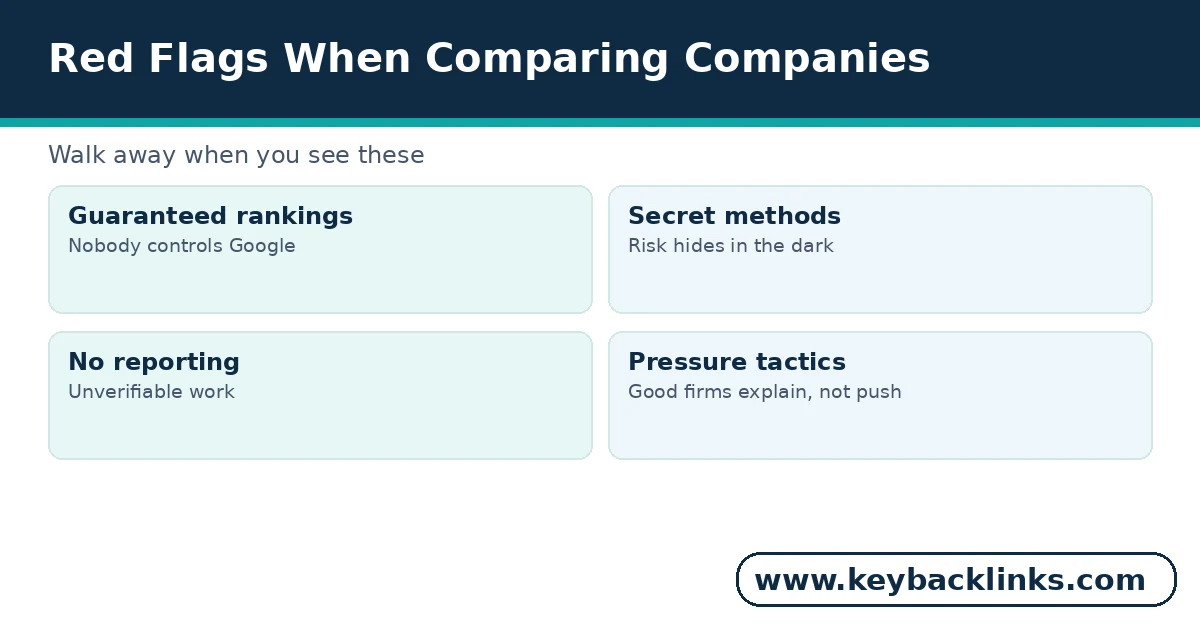
Guaranteed rankings lead the list. Secret methods follow close behind. Both ask you to trust claims that nobody can verify.
Pressure tactics form the next group. Discounts that expire today serve the seller only. Warnings that rivals will take your slot do the same. A calm provider lets its evidence close the sale.
Finally, watch for owned link networks and rented authority. When a provider owns the sites that will link to you, it sells its own inventory as outreach. That conflict of interest rarely ends well.
Also, distrust offers that exist only in conversation. When prices, tasks and timelines never reach paper, the provider keeps every exit open. Written scope protects both sides, and honest firms know it. A refusal to write things down is itself a red flag.
Specialist Provider or Full Service Agency?
Not every strong provider sells everything. A full service agency covers strategy, content, technical work and links under one roof. A specialist, in contrast, masters one craft, such as link building or content.
Choose a full service agency when your team lacks SEO skills entirely. One contract then covers the whole program, and one contact owns the plan. However, depth can vary inside a broad offer.
Choose a specialist when your foundations already work. For example, many teams fix their site in house, then hire link specialists for authority. Our services page shows how one specialist menu looks in practice.
Coordination forms the main trade off. One agency keeps every task under one plan and one invoice. Two providers, in contrast, need you to align their work yourself. That effort stays small when both sides report clearly. It grows painful when either side hides its tasks. Therefore, score communication twice as strictly when you split the work between providers.
The best seo company in usa for you may therefore be two providers, not one. Score each one for its own craft. Then judge how well the pair could work together.
How KeyBacklinks Scores Against This Rubric
Fairness demands that we face our own test. KeyBacklinks is a specialist link building provider, not a full service agency. We state that limit openly, because strategy fit starts with honesty. We also do not claim the best seo company in usa title for ourselves.
On method safety, our methods sit in writing on this site. We build editorial links, guest posts and niche edits on relevant sites. Paid placements carry the correct labels, and we refuse networks, blasts and comment spam.
On value clarity, our packages page publishes service levels and prices in the open. You can compare our scope against any rival before a single call. On communication, you get one named contact and plain monthly reports. Those reports list live URLs, anchors, target pages and dates.
On track record, we show our work plainly and let you check it. We also refuse to guarantee rankings, because that promise would fail this rubric at once. If that standard suits you, request a quote and put us through your own scoring.
Put the Framework to Work This Week
Start with three or four names from any source you trust. Score each one with the rubric during a single focused hour. Then call only the top two scorers.
Use the first call questions, and score again with the new answers. Check the winner’s contract against the clauses above. In short, let evidence carry every step of your search for the best seo company in usa, from first click to final signature.
Give the process one week, not one afternoon. Day one gathers names and evidence packs. Day two scores the shortlist on paper. Days three and four hold the two calls, and day five reviews the winning contract. That calm pace stops impulse signing, which is how most bad contracts begin.
Frequently Asked Questions
How do I choose the best seo company in usa?
Start with your goals, then score each candidate on the same five criteria. Check strategy fit, method safety, communication, value clarity and track record. Finally, verify the winner’s contract and references yourself before the first payment leaves your account.
Should the best seo company in usa guarantee first page rankings?
No. Google controls the results, so no provider can promise a position honestly. A guarantee signals either risky methods or empty sales talk. Choose the provider that explains its process and its limits instead.
Is a specialist provider better than a full service agency?
Neither type wins by default. A specialist suits teams with sound foundations and one clear gap. A full service agency suits teams that need the whole program managed. Score both types against your actual gap.
How long should I test a new SEO company before judging it?
Judge communication and delivery from the first month. Judge ranking movement over several months, beside your wider SEO work. Above all, judge the reporting every month, because honest reports show whether the work deserves more time.
Conclusion
The best seo company in usa is not a fixed name on a list. It is the provider that passes your tests for your goals, your market and your stage. Lists can supply names, but only evidence can supply confidence.
Use the rubric, ask the questions and check the contract. Then hire calmly, review monthly and expect steady progress instead of miracles. That approach protects your budget and your rankings at the same time.